
Digital Marketing for Recruitment Agencies
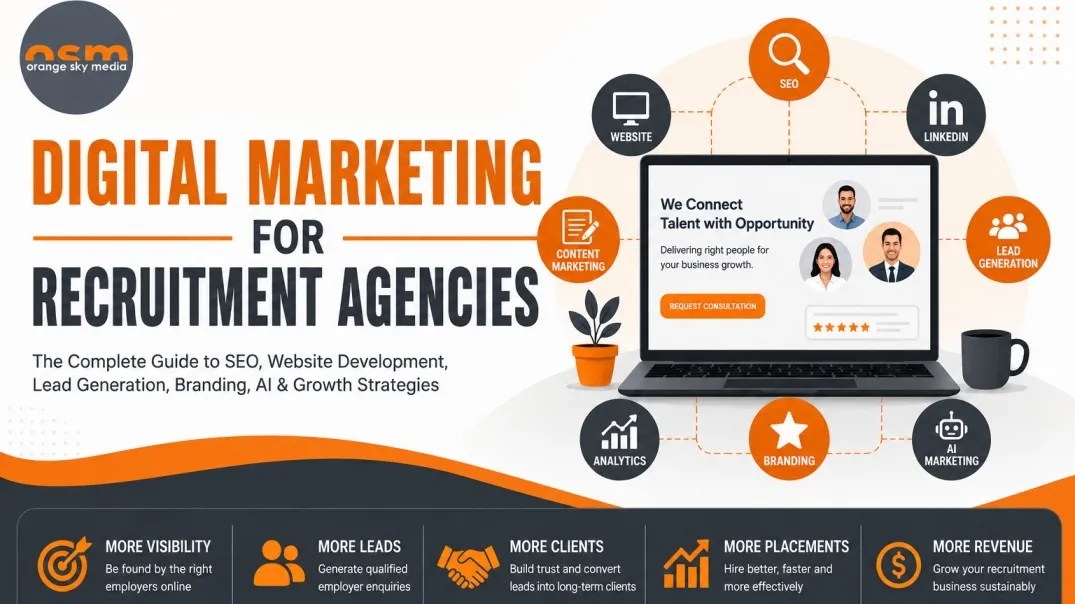
Table of Contents
Helping Recruitment Businesses Grow Through SEO, Branding, Content & Lead Generation
Introduction
The recruitment industry has evolved dramatically over the last decade. Companies no longer rely only on referrals, newspaper advertisements, or recruitment directories to find hiring partners. Before contacting a recruitment agency, most employers conduct online research. They compare agencies, visit websites, read case studies, check Google reviews, browse LinkedIn profiles, and evaluate industry expertise before making a decision.
This shift has fundamentally changed how recruitment agencies acquire new business.
Today, having a website alone is no longer enough. Agencies need a strong digital presence that builds trust, demonstrates expertise, and makes it easy for potential clients to find them online. Whether an agency specializes in executive search, overseas recruitment, marine crew management, healthcare staffing, construction manpower, or IT hiring, digital marketing has become one of the most reliable ways to attract qualified employers and generate long-term business growth.
At Orange Sky Media, we have seen this transformation firsthand while working on digital marketing strategies for an international recruitment company. One of the biggest lessons we learned was that employers rarely search using broad terms like “recruitment agency.” Instead, they search for specific hiring requirements such as:
- Marine crew recruitment agency
- Healthcare staffing agency
- Oil and gas recruitment company
- International manpower supplier
- Hospitality recruitment agency
- Executive search firm
- Overseas recruitment consultants
Understanding this search behaviour completely changes the way recruitment agencies should approach SEO, website development, content marketing, and lead generation.
Over time, a structured digital marketing strategy helped improve online visibility significantly. The recruitment websites attracted more than 30,000 organic Google clicks, generated over 1.2 million search impressions, and welcomed 41,000 website visitors from countries including India, Russia, the UAE, Saudi Arabia, Qatar, and the United States. These efforts also contributed to 466 qualified employer leads through digital channels.
These results reinforced an important lesson:
Recruitment marketing is not about attracting everyone. It is about being visible when the right employer is searching for the right hiring solution.
That is exactly what this guide is designed to help you achieve.
Whether you own a boutique recruitment agency, an international staffing company, a marine manning business, or an executive search firm, this guide will walk you through the complete digital marketing framework used to build visibility, generate employer enquiries, strengthen your brand, and create a sustainable pipeline of new business.
Throughout this guide, we’ll cover practical strategies for:
- Search Engine Optimization (SEO)
- Recruitment website development
- LinkedIn and social media marketing
- Employer branding
- Content marketing
- Lead generation
- AI-powered marketing
- International recruitment marketing
- Measuring ROI and business growth
By the end, you’ll understand not only what digital marketing is for recruitment agencies, but how to build a system that consistently attracts employers and supports long-term growth.
Why this introduction works
This introduction is intentionally different from most online articles because it:
- Establishes the changing behaviour of recruitment buyers.
- Introduces your real-world experience without turning it into a sales pitch.
- Uses genuine performance data as supporting evidence rather than making unsupported claims.
- Sets clear expectations for what readers will learn.
- Naturally leads into the next section.
Chapter 1: Understanding the Modern Recruitment Industry
Why Traditional Marketing Is No Longer Enough for Recruitment Agencies
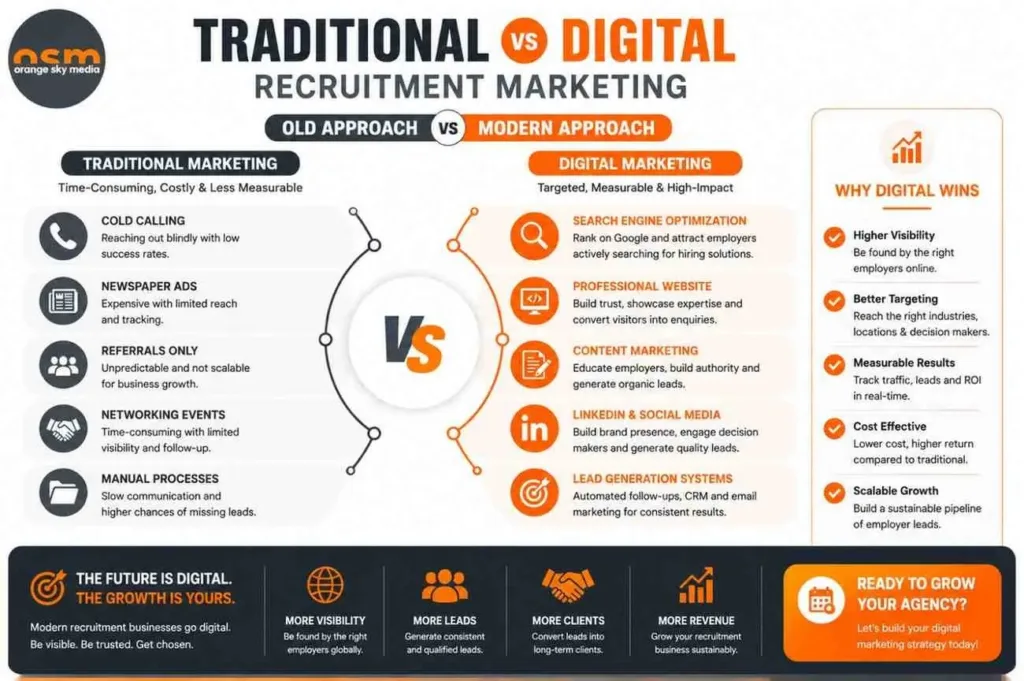
For many years, recruitment agencies grew their business through referrals, repeat clients, networking events, newspaper advertisements, and direct sales. While these methods can still produce results, they are no longer enough to sustain long-term growth in today’s competitive hiring market.
The way employers search for recruitment partners has changed.
When a company needs to hire skilled professionals, overseas workers, executive leaders, or temporary staff, the first step is often not picking up the phone. Instead, decision-makers open Google, LinkedIn, or another search platform to research potential recruitment partners. They compare agencies, review websites, read testimonials, and evaluate industry expertise before making an enquiry.
This shift means that a recruitment agency’s online presence has become just as important as its recruitment expertise.
If your agency cannot be found when employers are actively searching for hiring solutions, there is a good chance they will contact one of your competitors instead.
The Recruitment Industry Has Become More Competitive
The recruitment sector has experienced rapid growth over the past decade. New agencies enter the market every year, while established firms continue expanding into new industries and international markets.
At the same time, employer expectations have evolved.
Today’s clients expect recruitment partners to demonstrate:
- Industry expertise
- A professional and trustworthy website
- Active LinkedIn and social media presence
- Positive reviews and testimonials
- Valuable content and hiring insights
- Fast communication
- Proven recruitment experience
Recruitment agencies are no longer evaluated only by the number of candidates they can source. Employers increasingly look for agencies that present themselves as knowledgeable business partners who understand hiring challenges and industry trends.
This is where digital marketing plays a critical role.
Recruitment Marketing Is Different from Candidate Marketing
One of the biggest misconceptions in the recruitment industry is assuming that attracting candidates and attracting employers require the same marketing strategy.
They don’t.
Although both audiences visit the same website, their intentions, expectations, and decision-making processes are completely different.
| Employer Marketing | Candidate Marketing |
| Looking for a recruitment partner | Looking for a job |
| Wants hiring expertise | Wants career opportunities |
| Interested in recruitment services | Interested in vacancies |
| Evaluates trust and experience | Evaluates salary and benefits |
| Longer decision-making process | Faster application process |
Many recruitment agencies invest significant effort in publishing job vacancies while overlooking the employers who actually generate revenue.
A balanced marketing strategy should support both audiences, but employer-focused marketing often creates stronger long-term business growth because every new client can generate multiple recruitment assignments over time.
How Employers Search for Recruitment Agencies Today
Very few employers search using broad keywords such as:
- Recruitment Agency
- Staffing Company
- Manpower Consultant
Instead, they use highly specific search queries that reflect their immediate hiring requirements.
Examples include:
- Marine Crew Recruitment Agency
- Healthcare Staffing Agency in Dubai
- Oil and Gas Recruitment Company
- Construction Manpower Supplier
- Executive Search Firm for Manufacturing
- Hospitality Recruitment Agency
- International Recruitment Agency in India
- Overseas Recruitment Consultants
These searches reveal clear business intent.
The employer is not looking for general information. They are actively looking for a recruitment partner who specializes in a particular industry, location, or hiring requirement.
Understanding this behaviour is one of the foundations of successful recruitment marketing because it influences everything from SEO and website structure to content strategy and lead generation.
Why Many Recruitment Agencies Struggle Online
Many agencies offer excellent recruitment services but fail to generate consistent online inquiries because their digital presence does not reflect their expertise.
Some of the most common challenges include:
- Outdated websites that don’t build trust
- Poor search engine visibility
- No clear specialization by industry or location
- Limited educational content
- Inactive LinkedIn pages
- Weak employer branding
- Slow website performance
- No strategy for generating inbound employer leads
As a result, agencies often depend heavily on outbound sales, referrals, or repeat business, making growth unpredictable.
A well-planned digital marketing strategy helps reduce this dependency by creating a steady flow of qualified inbound enquiries from employers already searching for recruitment services.
A Real-World Perspective
Through our experience working on the digital growth of an international recruitment business, we observed that building visibility required much more than publishing job vacancies.
Growth came from creating targeted service pages, industry-specific content, country-focused landing pages, and SEO strategies aligned with the way employers actually search online. Over time, this approach contributed to more than 30,000 organic Google clicks, 1.2 million search impressions, 41,000 website visitors, and 466 employer leads generated through digital channels.
The key takeaway was simple:
Recruitment agencies that educate, specialize, and become visible online are far more likely to earn employer trust than agencies that rely solely on advertising vacancies.
Key Takeaways
Before investing in SEO, social media, or paid advertising, recruitment agencies should recognize these fundamental shifts:
- Employers research recruitment partners online before making contact.
- Digital credibility influences purchasing decisions.
- Employer marketing and candidate marketing require different strategies.
- Specialization creates stronger visibility than broad messaging.
- Long-term growth depends on building an online presence that attracts both trust and qualified inquiries.
Chapter 2: What Is Digital Marketing for Recruitment Agencies?
More Than Just a Website or Social Media
When people hear the term digital marketing, they often think of social media posts, Google Ads, or running occasional online campaigns. While these activities are part of digital marketing, they represent only a small piece of the bigger picture.
For recruitment agencies, digital marketing is the process of building a strong online presence that consistently attracts employers, strengthens your brand, generates qualified enquiries, and supports long-term business growth.
It is not about being active on every platform. It is about being visible where your potential clients are already searching for recruitment solutions.
A successful digital marketing strategy helps your agency become the preferred choice before a client even contacts your sales team.
Digital Marketing Is About Building Trust
Recruitment is a trust-based business.
When an employer outsources hiring, they are trusting another company with one of their most valuable business functions: finding the right people.
Before making that decision, employers naturally ask questions such as:
- Does this agency specialize in my industry?
- Have they worked with companies like mine?
- Do they understand international recruitment?
- Can they supply skilled professionals?
- Are they experienced and reliable?
- What do their clients say about them?
Digital marketing answers these questions before the first phone call.
Your website, blogs, LinkedIn profile, case studies, testimonials, and Google presence work together to establish credibility and reduce uncertainty.
By the time a potential client submits an enquiry, much of the trust-building process has already taken place online.
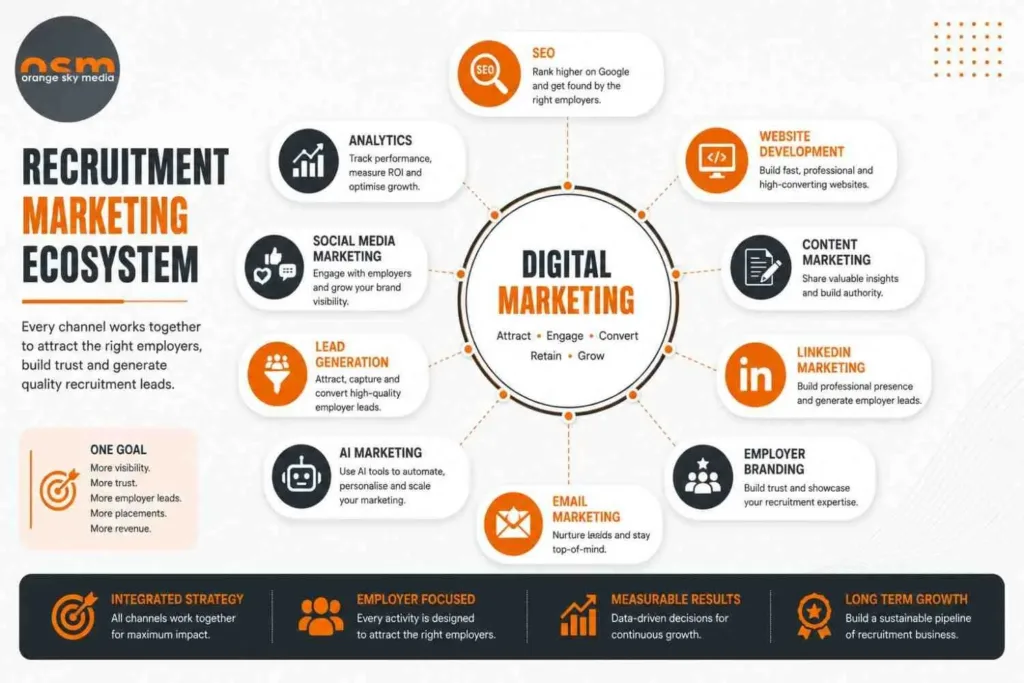
Digital Marketing Is a Complete Ecosystem
Many recruitment agencies focus on only one marketing activity, such as running Google Ads or posting jobs on LinkedIn.
However, sustainable growth comes from integrating multiple channels into a single marketing system.
Think of digital marketing as a connected ecosystem where every element supports the others.
| Digital Marketing Activity | Business Purpose |
| Search Engine Optimization (SEO) | Help employers find your agency on Google |
| Website Development | Build credibility and convert visitors into enquiries |
| Content Marketing | Educate employers and demonstrate expertise |
| LinkedIn Marketing | Build authority and professional visibility |
| Social Media Marketing | Increase brand awareness and engagement |
| Employer Branding | Build trust and strengthen reputation |
| Google Business Profile | Improve local visibility and enquiries |
| Email Marketing | Nurture prospects and stay connected with clients |
| AI & Marketing Automation | Improve efficiency and scale marketing efforts |
| Analytics & Reporting | Measure performance and optimize campaigns |
Each activity contributes to the same objective: helping the right employers discover your agency, trust your expertise, and contact your team.
The Recruitment Marketing Funnel
Unlike e-commerce businesses, recruitment agencies rarely convert visitors into clients immediately.
Hiring decisions often involve multiple stakeholders, discussions, and evaluations before an employer chooses a recruitment partner.
A typical recruitment marketing journey looks like this:
Stage 1: Awareness
The employer realizes they need recruitment support.
They search online using terms such as:
- Marine Recruitment Agency
- Healthcare Staffing Company
- Executive Search Firm
- International Recruitment Agency
At this stage, your visibility matters.
Stage 2: Research
The employer visits several recruitment websites and compares:
- Services
- Industries served
- Experience
- Client testimonials
- Case studies
- Website quality
- LinkedIn activity
This is where branding and content become critical.
Stage 3: Evaluation
The employer narrows the shortlist.
They may:
- Read your blog articles.
- Download resources.
- Review your company profile.
- Explore your recruitment process.
- Check Google reviews.
- Visit your LinkedIn page.
Every interaction increases or decreases trust.
Stage 4: Enquiry
Only after building sufficient confidence does the employer:
- Submit a contact form.
- Call your office.
- Send an email.
- Connect on LinkedIn.
- Request a proposal.
Digital marketing has successfully generated a qualified business opportunity.
Stage 5: Long-Term Relationship
Winning the first project is only the beginning.
A positive recruitment experience often leads to:
- Repeat hiring assignments
- Long-term staffing contracts
- Referrals
- Cross-industry opportunities
- International hiring partnerships
This is why recruitment marketing should focus not only on generating leads but also on building lasting client relationships.
Digital Marketing Is an Investment, Not an Expense
Many agencies hesitate to invest in digital marketing because they compare it with the cost of traditional advertising.
However, digital marketing should be viewed differently.
A well-optimized website, valuable content, and strong SEO continue generating enquiries long after they are created.
For example, a detailed guide about overseas recruitment or marine crew hiring can attract visitors for years, unlike a newspaper advertisement that disappears after a single day.
Similarly, improving your Google rankings can reduce reliance on expensive paid advertising by consistently bringing in organic traffic.
Over time, these digital assets compound in value, making digital marketing one of the most cost-effective growth strategies available to recruitment agencies.
A Practical Example
In our experience supporting the digital growth of an international recruitment company, success did not come from one marketing activity alone.
It was the result of combining:
- SEO-focused website architecture
- Industry-specific service pages
- Country and location-based landing pages
- Content marketing
- Google Business Profile optimization
- LinkedIn growth
- Continuous website improvements
Together, these efforts increased online visibility, attracted visitors from multiple countries, and generated hundreds of qualified employer enquiries through digital channels.
This demonstrates an important principle:
The most successful recruitment agencies don’t rely on a single marketing tactic. They build an integrated digital ecosystem that supports every stage of the employer’s decision-making journey.
Key Takeaways
Digital marketing for recruitment agencies is about much more than promoting vacancies or posting on social media. It is a strategic approach to increasing visibility, building trust, attracting qualified employers, and creating a predictable pipeline of business opportunities.
By combining SEO, content, websites, branding, social media, AI, and analytics into one cohesive system, recruitment agencies can position themselves as trusted hiring partners in an increasingly competitive market.
Chapter 3: Why Recruitment Agencies Need Digital Marketing More Than Ever
The Recruitment Industry Has Changed. Has Your Marketing Changed Too?
The recruitment industry has never been more competitive.
Across almost every sector, from healthcare and engineering to IT, hospitality, manufacturing, construction, and marine recruitment, new agencies are entering the market every month. At the same time, employers have become more selective about the recruitment partners they choose.
This isn’t because recruitment agencies have become less capable. It’s because the way businesses discover and evaluate recruitment services has fundamentally changed.
Years ago, an agency could rely heavily on referrals, networking, and repeat business. While those channels are still valuable, they no longer provide predictable growth on their own.
Today’s employers are digital-first.
Before contacting a recruitment agency, they typically spend time researching online, comparing agencies, reviewing websites, checking LinkedIn profiles, reading testimonials, and looking for evidence that an agency understands their industry.
In many cases, your digital presence becomes your first interview with a potential client.
If that first impression is weak, outdated, or difficult to find, the opportunity may be lost before your sales team even knows the employer was searching.
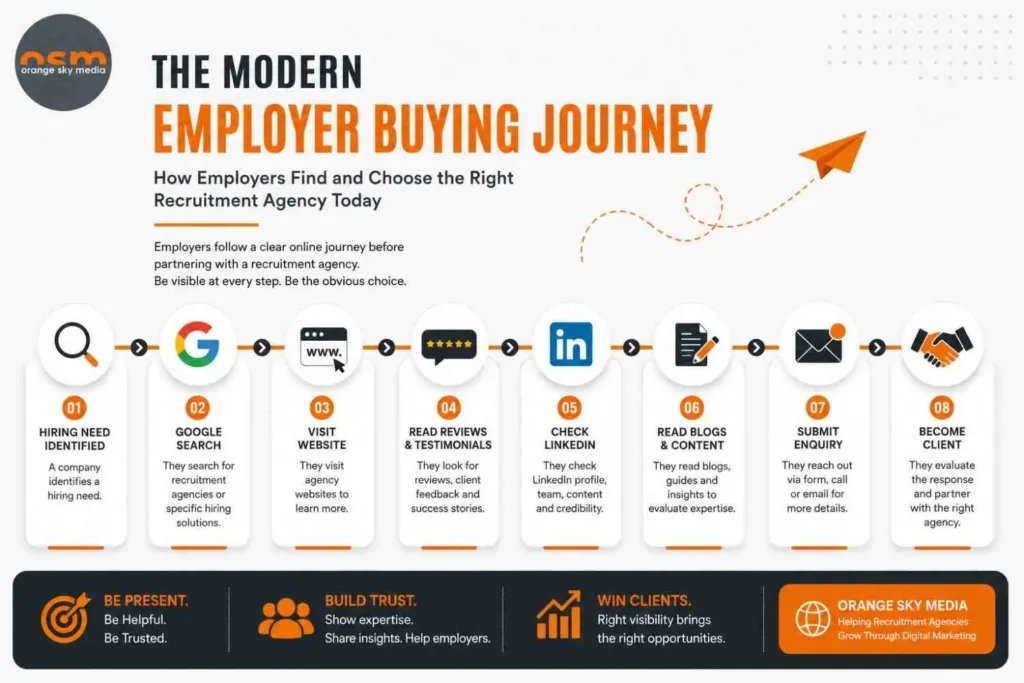
The Employer Buying Journey Has Changed
Recruitment agencies often focus on how candidates search for jobs.
However, winning recruitment contracts requires understanding how employers search for recruitment partners.
A typical employer journey now looks like this:
A hiring need arises
The company needs skilled workers, executives, project-based staff, or overseas manpower.
↓
Online research begins
Instead of immediately contacting an agency, they search Google using specific hiring requirements.
↓
Multiple agencies are compared
They visit several websites, compare services, industries served, experience, client testimonials, and overall professionalism.
↓
Trust is established
The employer looks for signs that the agency understands their business.
↓
An enquiry is submitted
Only after confidence has been built does the employer make contact.
This entire process often happens before the first phone call.
That is why digital marketing is no longer optional.
It influences every stage of the employer’s decision-making process.
Employers Don’t Buy Recruitment Services. They Buy Confidence.
This is one of the biggest lessons we’ve learned while working with recruitment businesses.
Employers are not simply looking for someone to source candidates.
They are looking for a recruitment partner who understands:
- Their industry
- Hiring challenges
- Compliance requirements
- Recruitment timelines
- Candidate quality
- International hiring regulations
- Workforce planning
Digital marketing gives recruitment agencies the opportunity to demonstrate this expertise before the first conversation.
A detailed industry guide, an informative case study, or a well-written service page often builds more confidence than a cold sales email.
Every blog article, every LinkedIn post, and every success story becomes part of your sales process.
Your Website Never Sleeps
One of the biggest advantages of digital marketing is that your website works for your business 24 hours a day.
While your recruitment consultants are attending meetings or interviewing candidates, your website can:
- Answer employer questions
- Showcase recruitment expertise
- Display case studies
- Generate enquiries
- Build credibility
- Collect leads
- Educate potential clients
Unlike traditional marketing, which stops when a campaign ends, your website continues working around the clock.
Every optimized page becomes another opportunity to be discovered by employers searching online.
Digital Marketing Creates Long-Term Business Assets
Traditional advertising usually delivers short-term visibility.
Once the advertisement ends, the exposure disappears.
Digital marketing works differently.
Every high-quality asset you create continues providing value over time.
For example:
- A well-written SEO page can attract visitors for years.
- A recruitment industry guide can become a trusted resource.
- A LinkedIn article can continue generating engagement months after publication.
- A case study can influence future buying decisions.
- A Google Business Profile can drive calls from nearby employers.
- A helpful blog can answer questions that employers search for every day.
Instead of constantly paying for visibility, you begin building digital assets that continue attracting potential clients.
Digital Marketing Makes Your Expertise Visible
Many recruitment agencies have years of experience, excellent recruiters, and strong client relationships.
Yet very few communicate that expertise effectively online.
Ask yourself these questions:
- Does your website explain your recruitment process?
- Do you publish hiring insights?
- Can employers understand which industries you specialize in?
- Do you demonstrate your success through case studies?
- Are you educating employers before they contact you?
If the answer is no, your expertise remains invisible.
Digital marketing transforms experience into visibility.
And visibility creates opportunities.
The Cost of Doing Nothing
Many agencies delay digital marketing because they are busy managing daily recruitment activities.
Ironically, this is often when they need it most.
Without a long-term digital strategy, agencies often become dependent on:
- Referrals
- Cold calling
- Existing clients
- Recruitment portals
- Temporary advertising campaigns
While these channels may generate business, they rarely create a predictable pipeline of new employer enquiries.
A strong digital presence provides another source of opportunities, reducing reliance on any single acquisition channel.
A Practical Example
During the digital growth of an international recruitment company, consistent investment in SEO, content, LinkedIn, and website improvements contributed to measurable growth over time.
Rather than relying on one marketing tactic, multiple digital channels worked together to increase search visibility, attract visitors from several countries, strengthen employer awareness, and generate hundreds of qualified enquiries.
The lesson was clear:
Digital marketing is most effective when treated as an ongoing business strategy rather than a one-time campaign.
Signs Your Recruitment Agency Needs Digital Marketing
Your agency will benefit from a stronger digital strategy if:
- Your website receives very few employer enquiries.
- Most business comes from referrals alone.
- You struggle to rank on Google.
- Your competitors appear ahead of you in search results.
- Your LinkedIn page has limited engagement.
- You rarely publish helpful content.
- Employers don’t clearly understand your specialization.
- You depend heavily on outbound sales.
Even improving a few of these areas can significantly strengthen your online presence over time.
Key Takeaways
Digital marketing is no longer just another promotional activity for recruitment agencies. It has become a critical part of how employers discover, evaluate, and select recruitment partners.
Agencies that invest in building their online presence gain more than visibility. They create trust, demonstrate expertise, educate potential clients, and build a sustainable source of employer enquiries.
Those that delay digital transformation risk becoming less visible in an increasingly competitive market where buying decisions often begin long before the first conversation.
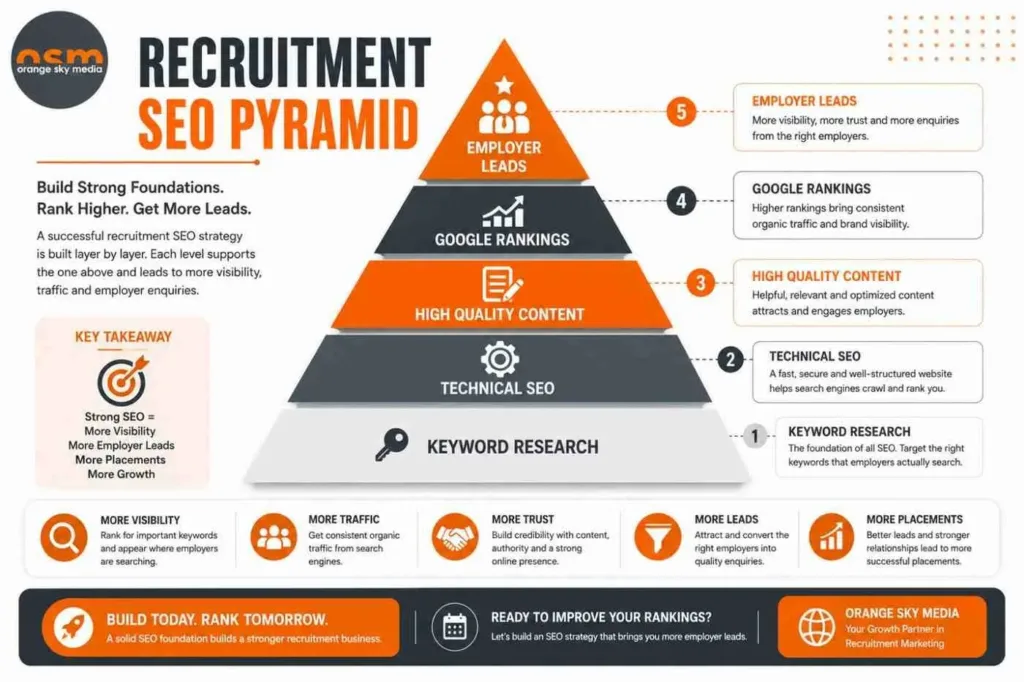
Chapter 4: SEO for Recruitment Agencies
Helping Employers Find Your Recruitment Agency on Google
Search Engine Optimization (SEO) is one of the most effective long-term marketing strategies for recruitment agencies. While paid advertising can generate immediate traffic, SEO helps your agency attract qualified employers consistently without paying for every click.
When an employer searches on Google for services such as Marine Crew Recruitment Agency, Healthcare Staffing Company, or International Recruitment Consultants, your website should appear among the top results. If it doesn’t, your competitors are more likely to receive those enquiries.
SEO is not simply about ranking higher on Google. It is about connecting your recruitment services with employers who are actively looking for hiring solutions.
Why SEO Matters for Recruitment Agencies
Employers rarely search using broad terms like Recruitment Agency. Instead, they use highly specific keywords that reflect their hiring needs, industry, or location.
For example:
- Marine Crew Recruitment Agency
- Healthcare Staffing Agency in Dubai
- Oil and Gas Recruitment Company
- Executive Search Firm
- Construction Manpower Supplier
- Overseas Recruitment Agency in India
These searches indicate strong business intent. The employer is not casually browsing but actively looking for a recruitment partner. Appearing in these search results can significantly increase your chances of generating qualified enquiries.
The Key Components of Recruitment SEO
An effective SEO strategy involves several elements working together:
Keyword Research
Understanding how employers search online helps you create pages that match their hiring requirements.
Service Pages
Develop dedicated pages for each recruitment service, such as executive search, permanent recruitment, temporary staffing, overseas recruitment, or RPO services.
Industry Pages
Showcase expertise by creating pages for industries like healthcare, marine, IT, manufacturing, hospitality, construction, logistics, and engineering.
Location Pages
Target cities, states, and countries where you operate. Local and international location pages improve visibility for employers searching in specific regions.
Content Marketing
Publish blogs, hiring guides, case studies, and industry insights that answer employer questions and demonstrate your expertise.
Technical SEO
Ensure your website loads quickly, works well on mobile devices, has a secure HTTPS connection, and provides a smooth user experience.
SEO Builds Long-Term Business Value
Unlike paid campaigns that stop delivering results when the budget ends, SEO creates digital assets that continue attracting traffic over time.
Every optimized service page, industry guide, or informative blog becomes another opportunity for employers to discover your agency through search engines.
As your website grows with high-quality, relevant content, search engines recognize your expertise and improve your visibility for important recruitment-related keywords.
Our Experience
While working on the digital growth of an international recruitment company, we found that SEO success came from building a structured website with dedicated service pages, industry-specific content, country-focused landing pages, and valuable educational resources. This strategy helped increase organic visibility, attract employers from multiple countries, and contribute to hundreds of qualified business enquiries through search.
Key Takeaway
SEO is more than a marketing technique. It is the foundation of a sustainable online presence. Recruitment agencies that invest in SEO become easier to find, build stronger credibility, and create a consistent pipeline of employer enquiries over time.
Learn More: In our complete guide, SEO for Recruitment Agencies, we explain keyword research, on-page SEO, technical SEO, local SEO, international SEO, and link-building strategies in detail.
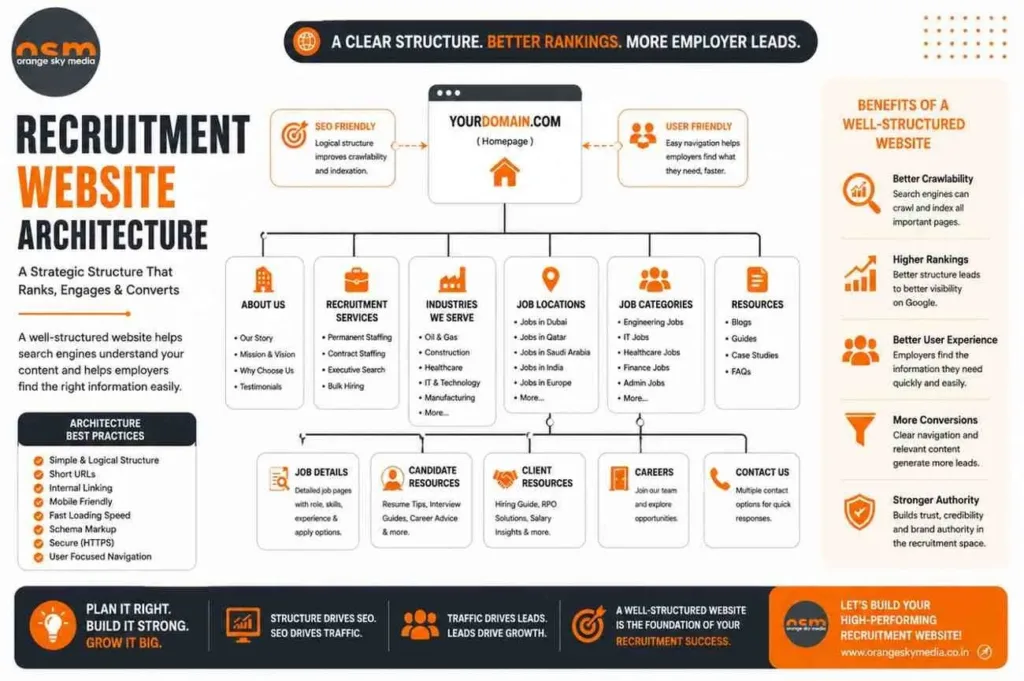
Chapter 5: Website Development for Recruitment Agencies
Your Website Is Your Most Powerful Sales Tool
In today’s digital world, a recruitment agency’s website is often the first interaction a potential client has with the business. Before making a phone call or sending an enquiry, employers visit your website to understand who you are, what industries you serve, and whether you have the expertise to handle their hiring needs.
A professional website is no longer just an online brochure. It acts as your digital office, sales representative, and marketing platform, working around the clock to attract and convert potential clients.
Whether you specialize in executive search, overseas recruitment, healthcare staffing, marine crew management, or temporary workforce solutions, your website should clearly communicate your expertise and make it easy for employers to take the next step.
Why Website Design Matters
Research shows that users form an opinion about a website within a few seconds. If your website looks outdated, loads slowly, or is difficult to navigate, potential clients may leave before learning about your services.
A modern recruitment website should immediately answer key questions:
- Who are you?
- What recruitment services do you offer?
- Which industries do you specialize in?
- Which countries or locations do you serve?
- Why should employers choose your agency?
- How can they contact you?
Clear messaging and intuitive navigation help visitors quickly find the information they need and build confidence in your business.
Essential Pages Every Recruitment Website Should Have
A high-performing recruitment website is built around the needs of both employers and job seekers while maintaining a strong focus on lead generation.
Some of the most important pages include:
- Home Page
- About Us
- Recruitment Services
- Industry-Specific Recruitment Pages
- Location or Country Pages
- Employer Solutions
- Job Portal
- Case Studies
- Testimonials
- Blog and Resources
- Contact Page
Each page should have a clear purpose, relevant content, and a call to action that encourages visitors to get in touch.
Build for Employers, Not Just Candidates
Many recruitment agencies focus heavily on job listings, but employers are the decision-makers who generate long-term business.
Your website should provide valuable information that helps employers understand your recruitment process, industry expertise, compliance standards, and success stories.
Adding employer-focused content such as hiring guides, recruitment process explanations, and industry insights positions your agency as a trusted recruitment partner rather than simply a source of candidates.
Optimizing for User Experience
A well-designed website should be fast, secure, and easy to use across all devices.
Important website features include:
- Mobile-friendly design
- Fast loading speed
- Secure HTTPS connection
- Easy navigation
- Simple enquiry forms
- Clear call-to-action buttons
- Live chat or WhatsApp integration (if applicable)
- Accessible contact information
A positive user experience improves engagement, builds trust, and increases the likelihood that visitors will become clients.
Website and SEO Go Hand in Hand
A beautiful website alone is not enough if employers cannot find it through search engines.
Website development and SEO should work together from the beginning. Proper site architecture, optimized URLs, internal linking, fast performance, and well-structured content all contribute to better search visibility.
When combined with a strong SEO strategy, your website becomes a valuable long-term asset that continuously attracts qualified employer enquiries.
Our Experience
Through our work with international recruitment businesses, we found that improving website structure, creating dedicated service pages, developing industry-specific landing pages, and optimizing user experience significantly improved both search visibility and lead generation. These improvements supported sustained growth in website traffic and employer enquiries.
Key Takeaway
Your website is far more than a digital brochure. It is the foundation of your online presence and one of the most important tools for building credibility, generating employer enquiries, and supporting long-term business growth.
A well-planned recruitment website combines excellent design, valuable content, SEO best practices, and user-focused functionality to create an experience that converts visitors into clients.
Learn More: Read our complete guide on Website Development for Recruitment Agencies to explore website planning, UX design, conversion optimization, recruitment portals, technical SEO, and best practices in detail.
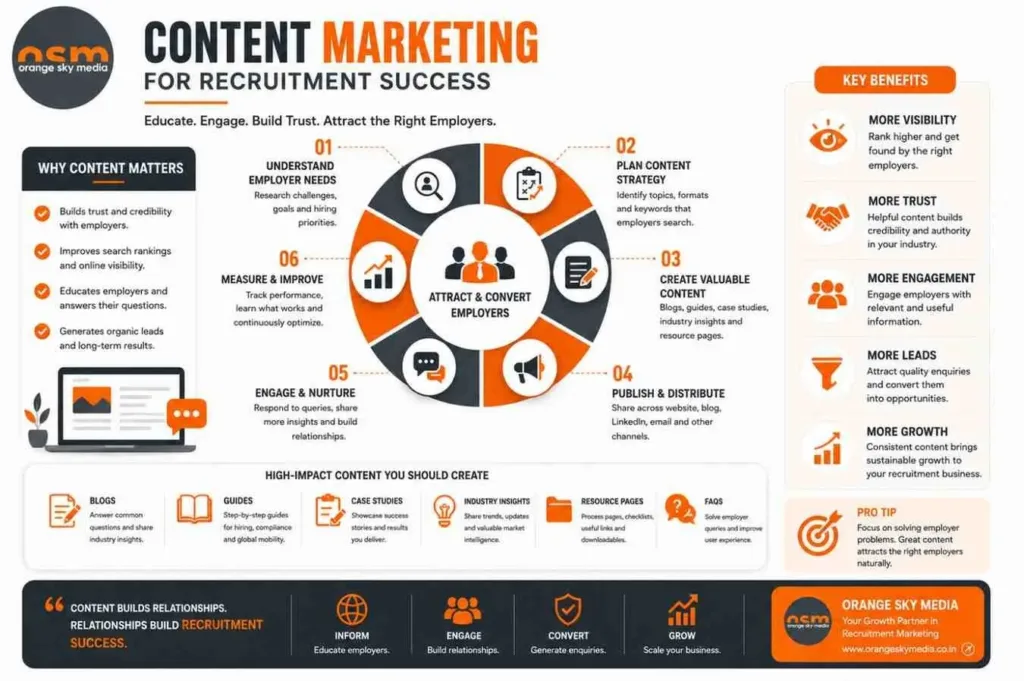
Chapter 6: Content Marketing for Recruitment Agencies
Educate First, Earn Trust, and Generate Better Leads
Content marketing is one of the most valuable long-term investments a recruitment agency can make. Instead of directly selling your services, content marketing focuses on answering questions, solving problems, and educating potential clients before they are ready to hire.
When employers search online, they are not always looking for a recruitment agency immediately. Often, they are researching hiring challenges, workforce trends, compliance requirements, salary benchmarks, or industry-specific recruitment solutions.
If your agency consistently provides valuable answers, you become a trusted resource long before a sales conversation begins.
This trust often leads to stronger relationships and higher-quality enquiries.
Why Content Marketing Matters
Recruitment is a knowledge-driven industry. Employers want to work with agencies that understand their business, hiring challenges, and industry requirements.
Publishing high-quality content allows your agency to demonstrate expertise without making exaggerated marketing claims.
Well-written content helps you:
- Build credibility with employers.
- Improve organic search rankings.
- Increase website traffic.
- Support your social media strategy.
- Generate qualified inbound enquiries.
- Establish your agency as an industry expert.
Over time, every article becomes another opportunity for employers to discover your business.
What Type of Content Should Recruitment Agencies Publish?
Many agencies limit their content to job postings, but employers are looking for much more than vacancies.
A strong content strategy should include topics that answer real business questions.
Examples include:
Hiring Guides
- How to Hire Marine Crew Efficiently
- International Recruitment Process Explained
- Steps to Recruit Skilled Workers from India
- Executive Search vs Traditional Recruitment
Industry Insights
- Hiring Trends in Healthcare
- Construction Workforce Challenges
- Manufacturing Talent Shortages
- Future of Offshore Recruitment
Employer Resources
- Recruitment Cost Guide
- Interview Best Practices
- Employee Retention Strategies
- Workforce Planning Tips
Case Studies
Show how your agency successfully solved hiring challenges for clients while maintaining confidentiality where necessary.
Case studies build credibility because they demonstrate real-world experience rather than simply describing your services.
Content Supports Every Marketing Channel
One blog article can be repurposed into multiple marketing assets.
For example, an article about Healthcare Recruitment can become:
- A LinkedIn article
- Several LinkedIn posts
- Social media graphics
- Email newsletter content
- Short videos
- Infographics
- Website FAQs
This approach saves time while ensuring consistent messaging across all digital channels.
Content Helps SEO
Every blog you publish creates another opportunity to rank on Google.
Instead of targeting only service-related keywords, content marketing allows you to rank for informational searches that employers make during their research process.
For example:
- How to Choose a Recruitment Agency
- Benefits of Overseas Recruitment
- Marine Crew Certification Requirements
- RPO vs Traditional Recruitment
- International Hiring Compliance
These articles attract potential clients earlier in their decision-making journey and guide them toward your recruitment services.
Quality Always Matters More Than Quantity
Publishing one helpful article each month is far more valuable than publishing multiple low-quality blogs.
Every piece of content should:
- Solve a genuine problem.
- Be factually accurate.
- Use simple, professional language.
- Include practical examples.
- Be optimized for search engines.
- Encourage readers to take the next step.
Consistent quality builds long-term trust with both readers and search engines.
Our Experience
While developing digital strategies for international recruitment businesses, we found that educational content consistently outperformed purely promotional content. Articles focused on employer challenges, recruitment processes, industry insights, and hiring best practices attracted more qualified visitors, strengthened search visibility, and supported lead generation efforts over time.
Key Takeaway
Content marketing is more than writing blogs. It is about sharing valuable knowledge that helps employers make informed hiring decisions.
When your recruitment agency consistently publishes useful, relevant, and trustworthy content, you build authority, strengthen SEO, increase visibility, and create lasting relationships with potential clients.
Rather than asking employers to trust you, your content demonstrates why they should.
Learn More: Read our complete guide on Content Marketing for Recruitment Agencies to discover content planning, blog strategy, topical authority, AI-assisted writing, and content distribution techniques.
Chapter 7: Social Media Marketing for Recruitment Agencies
Build Your Brand Where Employers Spend Their Time
Social media is no longer just a platform for sharing company updates or job vacancies. For recruitment agencies, it has become a powerful channel for building brand awareness, demonstrating expertise, engaging with employers, and establishing long-term professional relationships.
Today’s hiring managers, HR professionals, business owners, and decision-makers actively use social media to research companies, follow industry trends, and connect with trusted recruitment partners.
A consistent and professional social media presence helps your agency stay visible throughout the employer’s decision-making journey.
Why Social Media Matters
Many recruitment agencies only post job openings on social media.
While job postings are important for attracting candidates, employers are looking for something different.
They want to see evidence that your agency understands their industry, keeps up with hiring trends, and has experience solving recruitment challenges.
Social media gives you an opportunity to demonstrate that expertise every day.
It also keeps your agency visible even when potential clients are not actively hiring. When the need arises, your business is already familiar and trusted.
Choose the Right Platforms
Not every social media platform serves the same purpose.
Recruitment agencies should focus on the platforms that best support their business goals.
LinkedIn is the most valuable platform for B2B recruitment marketing.
It allows you to:
- Connect with HR professionals and business leaders.
- Share industry insights.
- Publish thought leadership content.
- Showcase company achievements.
- Build relationships with decision-makers.
For most recruitment agencies, LinkedIn should be the primary social media platform.
Facebook remains useful for building community engagement, promoting company culture, sharing recruitment updates, and running targeted advertising campaigns.
It also supports local employer outreach in many industries.
Instagram helps agencies humanize their brand by sharing behind-the-scenes content, employee stories, office culture, success stories, and visual updates.
While it is not always the primary lead-generation platform, it strengthens brand recognition.
YouTube
Video content continues to grow in importance.
Recruitment agencies can use YouTube to publish:
- Recruitment process guides
- Employer education videos
- Candidate preparation tips
- Industry insights
- Client success stories
- Company introductions
Video builds trust by allowing employers to see the people behind your agency.
Share Valuable Content, Not Just Vacancies
A successful social media strategy balances recruitment updates with educational and engaging content.
Examples include:
- Hiring trends
- Industry news
- Recruitment tips
- Case studies
- Client testimonials
- Employee success stories
- Compliance updates
- Hiring statistics
- Company milestones
- Event participation
This variety keeps your audience engaged and positions your agency as an industry expert.
Consistency Builds Trust
Posting regularly is more important than posting frequently.
A consistent posting schedule helps your audience recognize your brand and demonstrates that your agency is active and reliable.
Whether you publish three posts per week or one post every weekday, maintaining consistency is key to building credibility over time.
Planning content through a monthly social media calendar can help ensure a balanced mix of educational, promotional, and engagement-focused posts.
Measure Performance
Social media marketing should be guided by data rather than assumptions.
Track metrics such as:
- Reach
- Engagement
- Profile visits
- Website traffic
- Click-through rate
- Followers
- Enquiries generated
- Lead conversions
These insights help you understand what resonates with your audience and where to improve your strategy.
Our Experience
While managing digital marketing for an international recruitment company, LinkedIn played a significant role in strengthening brand visibility and professional credibility. By consistently sharing valuable content, company updates, and recruitment insights, the organization grew its professional audience and increased engagement with employers and industry professionals, supporting broader marketing and lead generation efforts.
Key Takeaway
Social media marketing is not about posting more content. It is about building meaningful relationships, demonstrating expertise, and staying visible to employers throughout their buying journey.
When integrated with SEO, website development, and content marketing, social media becomes a powerful tool for strengthening your recruitment brand and generating long-term business opportunities.
Learn More: Explore our complete guide on Social Media Marketing for Recruitment Agencies, where we cover LinkedIn strategy, content planning, paid campaigns, employer engagement, analytics, and platform-specific best practices.
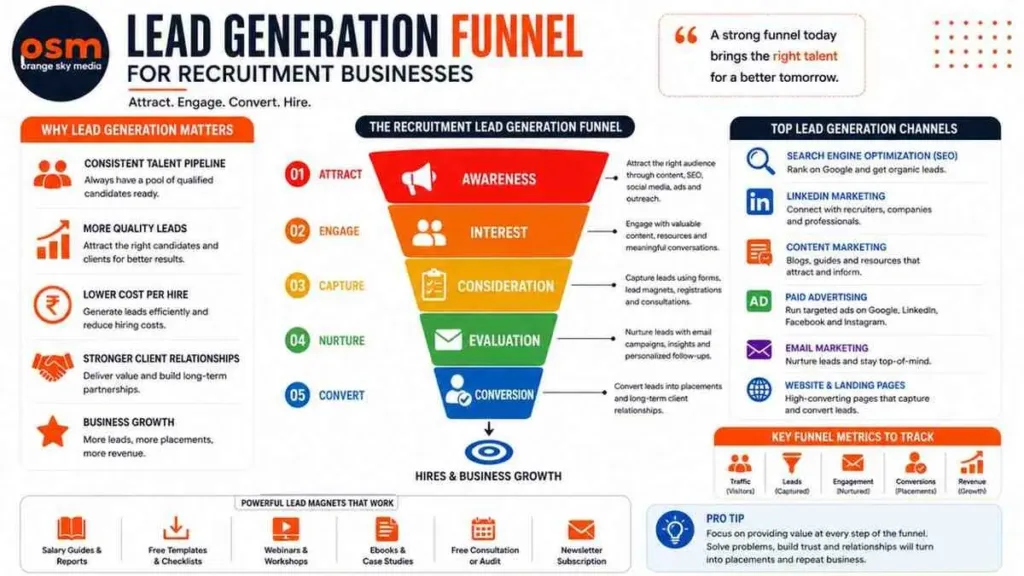
Chapter 8: Lead Generation for Recruitment Agencies
Turning Website Visitors into Qualified Employer Enquiries
Generating leads is the ultimate goal of every digital marketing strategy. While improving search rankings, building a professional website, and publishing valuable content are important, they only create business value when they result in qualified employer enquiries.
For recruitment agencies, lead generation is about creating a predictable system that consistently attracts companies looking for hiring solutions. Instead of relying solely on referrals, cold calling, or repeat clients, digital marketing enables agencies to build multiple channels that generate new business opportunities throughout the year.
A successful lead generation strategy focuses on attracting the right employers, building trust, and encouraging them to take action.
What Is a Qualified Recruitment Lead?
Not every enquiry is a valuable business opportunity.
A qualified lead is an employer who has a genuine hiring requirement and is actively looking for a recruitment partner.
Examples include:
- A hospital seeking experienced nurses.
- A shipping company hiring marine crew.
- A manufacturing company looking for skilled technicians.
- An IT company expanding its development team.
- A construction firm recruiting project engineers.
- A hospitality group hiring seasonal staff.
The objective is not to generate the highest number of enquiries but to attract businesses that match your expertise and services.
Build Multiple Lead Generation Channels
The most successful recruitment agencies do not depend on a single source of enquiries.
Instead, they develop several channels that work together to create a consistent flow of opportunities.
Organic Search (SEO)
Ranking for high-intent keywords allows employers to find your agency when they are actively searching for recruitment services.
This is often one of the highest-quality lead sources because employers already have a hiring requirement.
Website Enquiry Forms
Your website should make it simple for employers to contact your team.
Effective enquiry forms ask for only the essential information, making the process quick while collecting enough details to qualify the lead.
LinkedIn supports lead generation through professional networking, thought leadership, direct outreach, and relationship building with HR managers, business owners, and decision-makers.
Content Marketing
Helpful blogs, recruitment guides, and case studies educate employers while encouraging them to request consultations or recruitment support.
Google Business Profile
For agencies targeting local businesses, an optimized Google Business Profile can generate valuable phone calls, website visits, and direction requests from nearby employers.
Email Marketing
Email campaigns help nurture existing prospects, reconnect with previous clients, and maintain relationships with employers who may have future hiring needs.
Optimize Every Opportunity to Convert
Driving traffic to your website is only part of the process.
Every page should encourage visitors to take the next step.
Effective calls to action include:
- Request a Consultation
- Discuss Your Hiring Requirements
- Contact Our Recruitment Specialists
- Submit Your Workforce Requirements
- Book a Discovery Call
Place these calls to action naturally throughout your website instead of limiting them to the contact page.
Speed Matters
Employers often contact multiple recruitment agencies during their search.
Responding quickly can significantly improve your chances of securing new business.
Digital marketing should be supported by an efficient internal process that ensures enquiries are acknowledged, qualified, and followed up without unnecessary delays.
Fast communication reinforces professionalism and builds confidence in your services.
Measure Lead Quality
Lead generation should focus on quality as well as quantity.
Useful performance indicators include:
- Number of employer enquiries.
- Qualified leads.
- Consultation requests.
- Proposal requests.
- Conversion rate.
- Cost per lead (for paid campaigns).
- Client acquisition rate.
Tracking these metrics helps identify which marketing channels deliver the best return on investment.
Our Experience
Our experience with international recruitment marketing showed that the strongest lead generation results came from combining SEO, industry-specific landing pages, valuable content, LinkedIn visibility, and a professionally optimized website. Rather than relying on a single source, multiple digital channels worked together to generate qualified employer enquiries and support sustainable business growth.
Key Takeaway
Lead generation is not about collecting as many enquiries as possible. It is about creating a structured system that consistently attracts the right employers, builds trust, and converts interest into long-term recruitment partnerships.
When SEO, content marketing, website optimization, LinkedIn, and relationship-building strategies work together, recruitment agencies create a reliable pipeline of business opportunities that supports continuous growth.
Learn More: Read our complete guide on Lead Generation for Recruitment Agencies, where we explore inbound marketing, outbound outreach, conversion optimization, CRM strategies, email automation, and lead nurturing in greater detail.
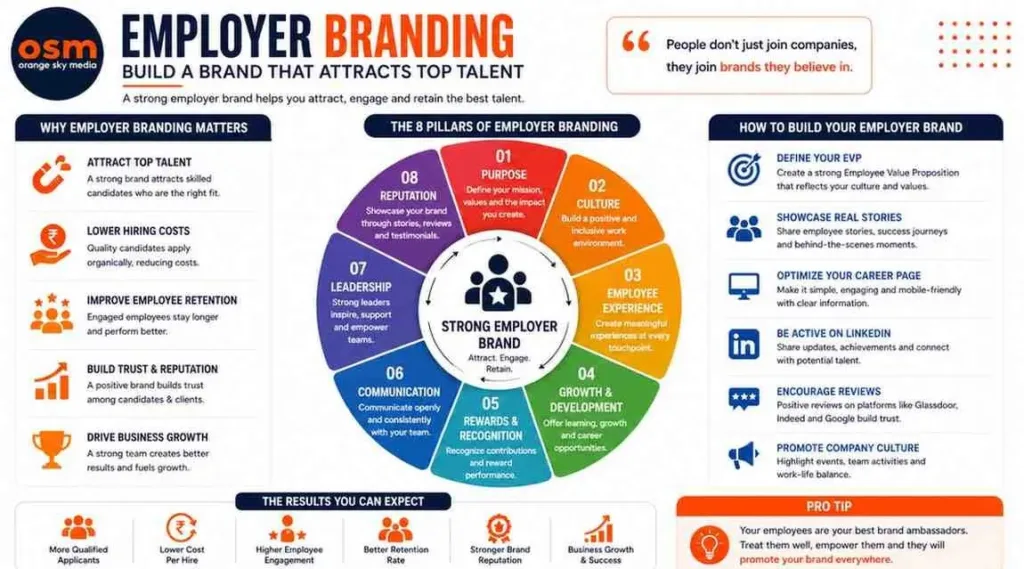
Chapter 9: Employer Branding for Recruitment Agencies
Build Trust Before the First Conversation
In the recruitment industry, employers are not only choosing a service provider. They are choosing a long-term hiring partner who will represent their organization, understand their workforce requirements, and help them find the right talent.
This is why employer branding has become an essential part of digital marketing.
A strong employer brand helps recruitment agencies build credibility, differentiate themselves from competitors, and create confidence before the first meeting or phone call.
When employers recognize your agency as knowledgeable, professional, and reliable, they are far more likely to trust you with their recruitment needs.
What Is Employer Branding?
Employer branding is how your recruitment agency is perceived by potential clients, candidates, and business partners.
It is shaped by every interaction someone has with your business, including:
- Your website
- LinkedIn presence
- Google Business Profile
- Client testimonials
- Case studies
- Social media activity
- Blog content
- Reviews
- Communication style
Together, these elements create an impression of who you are and whether employers can trust your agency.
A strong employer brand is built consistently over time through every touchpoint.
Why Employer Branding Matters
Recruitment is a relationship-driven business.
When employers outsource hiring, they expect professionalism, transparency, and industry expertise.
If two agencies offer similar services, employers often choose the one that appears more credible online.
A well-developed employer brand helps:
- Build trust with new clients.
- Differentiate your agency from competitors.
- Support premium pricing.
- Improve enquiry conversion rates.
- Strengthen long-term client relationships.
- Increase referrals and repeat business.
A trusted brand reduces uncertainty and makes the decision-making process easier for employers.
Elements of a Strong Recruitment Brand
Employer branding is not created by a logo alone.
It is the combination of several factors working together.
Professional Website
Your website should communicate expertise, showcase your services, and clearly explain the industries and locations you serve.
Client Testimonials
Positive feedback from satisfied clients provides social proof and reinforces credibility.
Case Studies
Real examples of successful recruitment projects demonstrate your ability to solve hiring challenges.
Thought Leadership
Publishing educational articles, recruitment insights, and industry trends positions your agency as a knowledgeable partner rather than simply another service provider.
Consistent Visual Identity
Maintain consistent branding across your website, social media platforms, proposals, presentations, and marketing materials.
Consistency strengthens recognition and builds confidence.
Showcase Your Expertise
Many recruitment agencies have years of experience but fail to communicate it effectively.
Share content that highlights your knowledge, including:
- Recruitment process guides.
- Industry hiring reports.
- Compliance updates.
- Market insights.
- Success stories.
- Workforce trends.
Providing valuable information helps employers understand that your agency offers more than candidate sourcing.
It demonstrates strategic recruitment expertise.
Reputation Management
Online reputation has become an important part of employer branding.
Encourage satisfied clients to leave reviews on platforms such as Google and LinkedIn.
Respond professionally to feedback and address concerns promptly.
A positive online reputation strengthens credibility and supports future lead generation efforts.
Branding Is an Ongoing Process
Employer branding is not built through a single campaign.
It develops gradually through consistent communication, quality service, and valuable content.
Every positive interaction strengthens your reputation.
Every helpful article increases trust.
Every successful placement reinforces your expertise.
Over time, these small efforts combine to create a recognizable and respected recruitment brand.
Our Experience
While supporting the digital growth of international recruitment businesses, we observed that agencies with consistent branding, informative content, active LinkedIn profiles, and professionally designed websites earned greater trust from employers. These elements worked together to strengthen online credibility and support long-term client acquisition.
Key Takeaway
Employer branding is one of the most valuable long-term assets a recruitment agency can build.
A trusted brand makes it easier to attract employers, generate enquiries, convert prospects into clients, and develop lasting business relationships.
By combining professional branding, valuable content, strong client relationships, and consistent communication, recruitment agencies can position themselves as trusted recruitment partners in a competitive marketplace.
Learn More: Read our complete guide on Employer Branding for Recruitment Agencies, where we explore brand positioning, reputation management, case studies, client testimonials, personal branding, and long-term trust-building strategies.
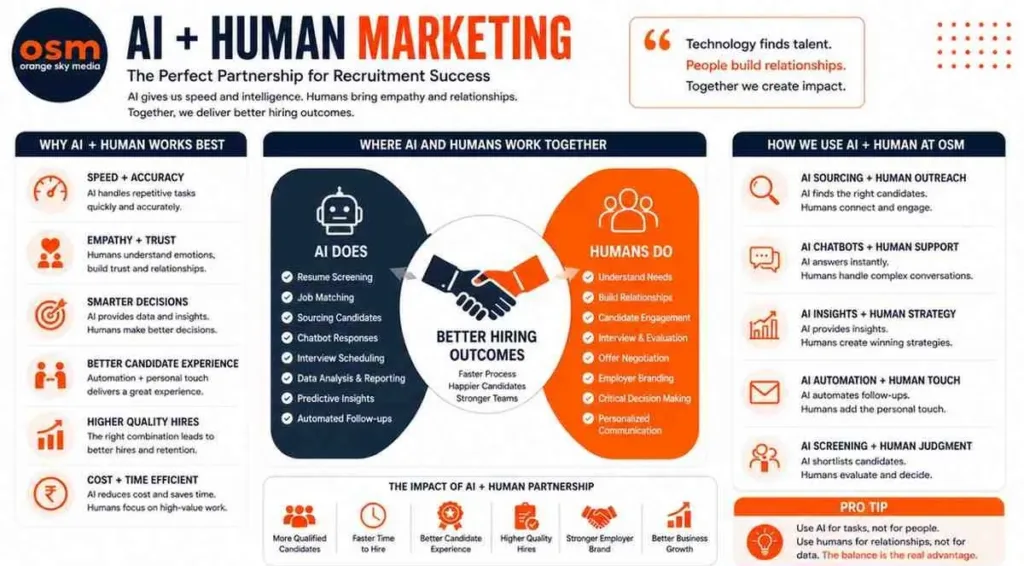
Chapter 10: AI in Recruitment Marketing
How Artificial Intelligence Is Transforming Recruitment Agency Growth
Artificial Intelligence (AI) is no longer a futuristic concept. It has become an essential part of how recruitment agencies market their services, engage with employers, analyze data, and improve operational efficiency.
While AI cannot replace the expertise, relationship-building, and decision-making skills of experienced recruiters, it can significantly improve how agencies attract clients, create content, automate repetitive tasks, and deliver better customer experiences.
For recruitment agencies that embrace AI strategically, it offers an opportunity to work smarter, respond faster, and scale marketing efforts without proportionally increasing costs.
AI Is a Tool, Not a Replacement
One of the biggest misconceptions about AI is that it will replace recruitment professionals.
In reality, AI works best as an assistant that supports your team.
Recruiters still provide:
- Industry expertise
- Candidate evaluation
- Relationship management
- Client consultations
- Negotiation skills
- Strategic hiring advice
AI simply helps automate repetitive processes and provides valuable insights that improve decision-making.
The most successful recruitment agencies combine human expertise with AI-powered efficiency.
How Recruitment Agencies Can Use AI
Artificial Intelligence supports multiple areas of digital marketing.
Content Creation
AI can help generate:
- Blog outlines
- Social media captions
- Email drafts
- Meta titles
- Meta descriptions
- FAQ ideas
- Content summaries
Human review remains essential to ensure accuracy, originality, and alignment with your agency’s expertise.
SEO Support
AI tools can assist with:
- Keyword research
- Content optimization
- Search intent analysis
- Topic clustering
- Internal linking suggestions
- Competitor research
These insights help agencies build stronger SEO strategies more efficiently.
Marketing Automation
AI-powered automation can streamline tasks such as:
- Email follow-ups
- Lead nurturing
- Appointment scheduling
- CRM updates
- Chatbot conversations
- Customer support
Automation reduces manual work while improving response times and customer experience.
Data Analysis
AI can quickly analyze large amounts of marketing data to identify:
- High-performing content
- Website trends
- Traffic sources
- Conversion patterns
- Campaign performance
- Audience behaviour
These insights help agencies make informed marketing decisions based on real performance data rather than assumptions.
AI Improves Productivity
Many marketing activities require significant time and effort.
AI helps agencies complete these tasks more efficiently, allowing marketing teams to focus on strategy, creativity, and relationship building.
Examples include:
- Drafting content faster.
- Organizing keyword research.
- Creating content calendars.
- Summarizing industry reports.
- Generating campaign ideas.
- Producing first drafts for emails and proposals.
This increased efficiency enables agencies to maintain a consistent marketing presence without compromising quality.
Use AI Responsibly
While AI offers significant advantages, it should not replace original thinking or industry expertise.
Recruitment agencies should:
- Verify AI-generated information.
- Add practical experience and real-world examples.
- Maintain a human tone.
- Protect confidential client information.
- Follow ethical and legal guidelines.
Authenticity remains one of the strongest competitive advantages in recruitment marketing.
The Future of Recruitment Marketing
AI will continue to influence how agencies communicate, market their services, and analyze performance.
However, employers will always value genuine expertise, transparent communication, and trusted business relationships.
Recruitment agencies that combine AI-powered efficiency with human experience will be better positioned to adapt to changing market expectations and deliver exceptional service.
Our Experience
In our own digital marketing projects, AI has become a valuable assistant for research, content planning, SEO analysis, and workflow optimization. However, the best results have always come from combining AI-generated ideas with practical recruitment industry experience, careful review, and a deep understanding of employer needs. This balanced approach helps maintain content quality while improving productivity.
Key Takeaway
Artificial Intelligence is changing the way recruitment agencies approach digital marketing, but it is not replacing the people behind successful recruitment businesses.
When used strategically, AI helps agencies save time, improve efficiency, strengthen marketing performance, and focus more on building relationships with employers.
The agencies that thrive in the coming years will not be those that rely entirely on AI, but those that use it to enhance human expertise and deliver greater value to their clients.
Learn More: Read our complete guide on AI for Recruitment Marketing, where we explore AI-powered SEO, content creation, automation, analytics, prompt engineering, and practical AI workflows for recruitment agencies.
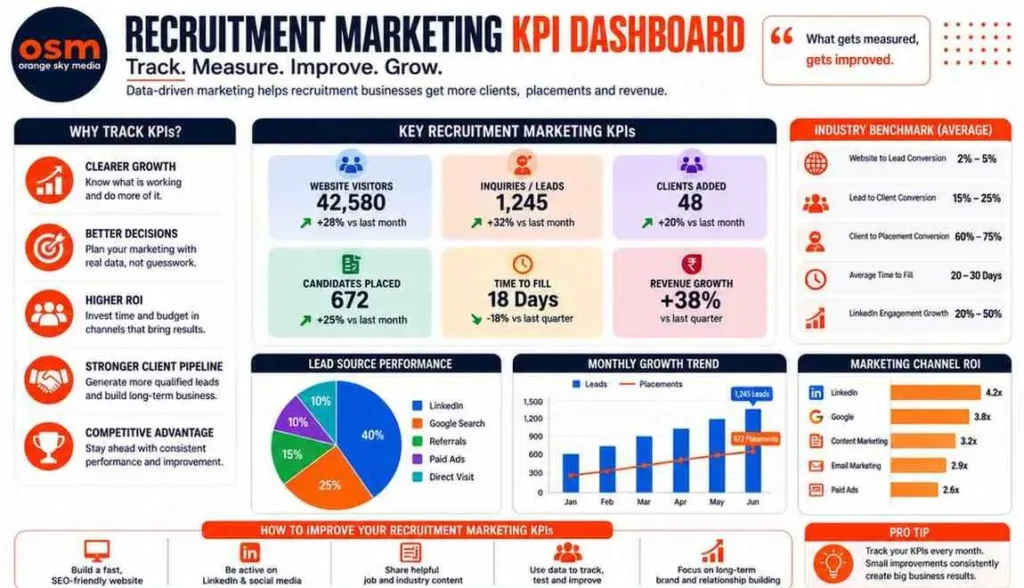
Chapter 11: Measuring Success – KPIs and ROI for Recruitment Marketing
How to Measure Whether Your Digital Marketing Is Actually Working
Digital marketing is an investment, and like any business investment, it should produce measurable results.
Many recruitment agencies publish content, improve their website, or post regularly on social media without tracking whether these efforts are generating employer enquiries or contributing to business growth.
Measuring performance helps you understand which marketing activities are delivering results, where improvements are needed, and how your marketing budget is contributing to revenue.
Instead of relying on assumptions, recruitment agencies should use data to guide their marketing decisions.
Why KPIs Matter
Key Performance Indicators (KPIs) are measurable values that show how effectively your marketing strategy is achieving its objectives.
For recruitment agencies, the goal is not simply to increase website traffic. The real objective is to attract qualified employers, generate enquiries, and convert those enquiries into long-term clients.
Tracking the right KPIs ensures that your marketing efforts remain aligned with your business goals.
Website Performance Metrics
Your website is often the starting point of the employer journey, making website performance one of the most important areas to monitor.
Key metrics include:
- Website visitors
- Organic traffic from search engines
- New vs returning visitors
- Average engagement time
- Pages viewed per session
- Bounce rate
- Contact form submissions
- Click-to-call actions
These metrics help you understand how employers interact with your website and identify opportunities to improve user experience.
SEO Performance Metrics
SEO is a long-term strategy, so measuring consistent progress is essential.
Monitor metrics such as:
- Keyword rankings
- Organic traffic growth
- Search impressions
- Click-through rate (CTR)
- Indexed pages
- Backlink growth
- Top-performing landing pages
- Featured snippets and AI Overview visibility (where applicable)
These indicators help evaluate how well your website is performing in search engines.
Lead Generation Metrics
Ultimately, recruitment marketing should generate business opportunities.
Important lead generation KPIs include:
- Employer enquiries
- Consultation requests
- Proposal requests
- Qualified leads
- Lead-to-client conversion rate
- Cost per lead (for paid campaigns)
- Client acquisition cost
Tracking these numbers helps identify which channels produce the highest-quality enquiries.
Social Media Metrics
Social media performance should be evaluated based on engagement and business impact rather than follower count alone.
Useful metrics include:
- Reach
- Impressions
- Engagement rate
- Profile visits
- Website clicks
- LinkedIn connection growth
- Enquiries generated through social media
Strong engagement often indicates that your content is relevant and valuable to your audience.
Email Marketing Metrics
If your recruitment agency uses email campaigns, monitor:
- Open rate
- Click-through rate
- Response rate
- Unsubscribe rate
- Meeting requests
- Enquiries generated
These metrics help refine messaging and improve campaign effectiveness.
Focus on Return on Investment (ROI)
Traffic alone does not pay the bills.
A successful recruitment marketing strategy should ultimately generate profitable business.
Ask questions such as:
- How many enquiries became clients?
- Which marketing channel generated the highest-quality leads?
- Which services attract the most enquiries?
- Which industries convert best?
- What is the average client value?
- How much revenue can be attributed to digital marketing?
Understanding ROI helps prioritize the strategies that create the greatest business impact.
Review Your Performance Regularly
Digital marketing is not a one-time project.
Regular reviews help identify trends, celebrate successes, and address weaknesses before they become major issues.
A monthly performance review should include:
- Website analytics
- SEO progress
- Lead generation results
- Social media performance
- Content performance
- Campaign effectiveness
- Goals for the following month
Consistent reporting supports continuous improvement.
Our Experience
While managing digital marketing initiatives for international recruitment businesses, performance tracking played a crucial role in refining strategy. Monitoring website traffic, search visibility, employer enquiries, and lead quality helped identify the activities that generated the strongest business outcomes, allowing marketing efforts to become more focused and effective over time.
Key Takeaway
Digital marketing should never be measured by traffic or social media followers alone.
The most meaningful indicators are qualified employer enquiries, client conversions, and business growth.
By tracking the right KPIs and regularly reviewing performance, recruitment agencies can make informed decisions, improve marketing effectiveness, and maximize the return on their digital marketing investment.
Learn More: Read our complete guide on Recruitment Marketing KPIs and ROI, where we explain Google Analytics, Search Console, Looker Studio dashboards, lead attribution, conversion tracking, and reporting best practices.
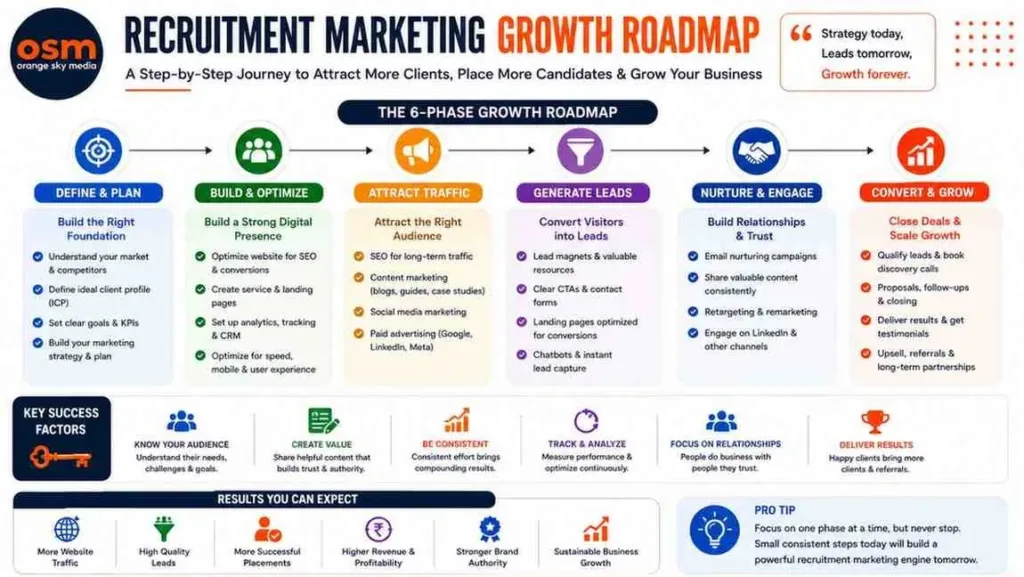
Chapter 12: Common Digital Marketing Mistakes Recruitment Agencies Should Avoid
Avoid These Mistakes to Build Sustainable Growth
Digital marketing has the potential to become one of the strongest growth drivers for a recruitment agency. However, many agencies invest time and money into online marketing without seeing meaningful results because they focus on the wrong priorities or overlook the fundamentals.
The good news is that most digital marketing mistakes are preventable.
By understanding these common challenges and addressing them early, recruitment agencies can build a stronger online presence, attract better-quality employer enquiries, and achieve more consistent business growth.
1. Treating Your Website Like a Digital Brochure
Many recruitment websites simply list their services and contact details.
Modern employers expect much more.
They want to understand:
- Your recruitment process.
- Industries you specialize in.
- Countries you serve.
- Success stories.
- Client testimonials.
- Recruitment expertise.
A website should educate, build trust, and encourage employers to contact your team, not simply describe your business.
2. Focusing Only on Job Postings
Publishing vacancies is important for attracting candidates, but it does little to attract employers.
Many agencies spend most of their marketing efforts promoting jobs while neglecting employer-focused content.
A balanced strategy should include:
- Recruitment service pages.
- Industry guides.
- Hiring advice.
- Case studies.
- Employer resources.
- Recruitment insights.
This demonstrates expertise and supports business development.
3. Ignoring Search Engine Optimization
Even the best recruitment website cannot generate enquiries if employers cannot find it.
Some agencies invest heavily in website design but overlook SEO fundamentals such as:
- Keyword research.
- Service page optimization.
- Technical SEO.
- Internal linking.
- Local SEO.
- Content strategy.
SEO should be integrated into your website from the beginning rather than added later.
4. Inconsistent Content Publishing
Publishing several articles in one month and then remaining inactive for the next six months limits long-term growth.
Search engines and employers both value consistency.
Developing a content calendar helps maintain regular publication of blogs, case studies, hiring guides, and recruitment insights.
Consistent publishing strengthens topical authority and keeps your agency visible.
5. Neglecting LinkedIn
LinkedIn is one of the most valuable platforms for B2B recruitment marketing, yet many agencies only update their company page occasionally.
Regularly sharing industry knowledge, recruitment trends, client success stories, and company updates helps strengthen professional credibility and keeps your agency visible to decision-makers.
6. Weak Calls to Action
Many recruitment websites provide valuable information but fail to encourage visitors to take the next step.
Every important page should include clear calls to action, such as:
- Request a Consultation
- Contact Our Recruitment Team
- Discuss Your Hiring Requirements
- Book a Discovery Call
- Submit Your Workforce Needs
Clear calls to action improve conversion rates and generate more enquiries.
7. Not Measuring Results
Without performance tracking, it is difficult to know whether your marketing strategy is working.
Recruitment agencies should regularly monitor:
- Website traffic.
- Employer enquiries.
- Search rankings.
- Lead conversions.
- Social media engagement.
- Campaign performance.
Data-driven decisions lead to continuous improvement.
8. Depending on One Marketing Channel
Many agencies rely almost entirely on referrals, Google Ads, or LinkedIn.
While these channels are valuable, depending on only one source creates unnecessary risk.
A stronger approach combines:
- SEO
- Website optimization
- Content marketing
- Social media
- Email marketing
- Google Business Profile
- Referral marketing
Diversifying your marketing channels creates a more stable and predictable pipeline of business opportunities.
9. Ignoring Mobile Users
A significant percentage of website visitors access recruitment websites from mobile devices.
If your website loads slowly, displays poorly on smaller screens, or makes it difficult to submit enquiries, potential clients may leave before contacting you.
A mobile-friendly website is no longer optional. It is an essential part of delivering a professional user experience.
10. Expecting Immediate Results
One of the biggest misconceptions about digital marketing is expecting instant success.
SEO, content marketing, employer branding, and organic lead generation require consistency and patience.
The agencies that achieve the best long-term results are those that continue investing in high-quality content, website improvements, and relationship building over time.
Digital marketing should be viewed as a long-term business strategy rather than a short-term campaign.
Our Experience
During our work with international recruitment businesses, the strongest digital marketing results came from agencies that focused on consistency rather than quick wins. Continuous improvements to websites, SEO, content, and employer engagement produced stronger long-term visibility, increased employer trust, and more sustainable lead generation.
Key Takeaway
Successful recruitment marketing is rarely about doing one thing exceptionally well.
It is about consistently doing many important things correctly.
By avoiding these common mistakes and building an integrated digital marketing strategy, recruitment agencies can strengthen their online presence, improve employer trust, generate better-quality enquiries, and create a sustainable foundation for long-term growth.
Frequently Asked Questions (FAQs)
1. What is digital marketing for recruitment agencies?
Digital marketing for recruitment agencies is the process of promoting recruitment services through online channels such as search engines, websites, content marketing, social media, LinkedIn, email marketing, and AI-powered tools. Its primary objective is to help agencies attract qualified employers, generate leads, build credibility, and grow their business.
2. Why is digital marketing important for recruitment agencies?
Today’s employers research recruitment agencies online before making contact. A strong digital presence helps agencies increase visibility, build trust, demonstrate expertise, and generate consistent employer enquiries instead of relying only on referrals or cold outreach.
3. Which digital marketing strategy works best for recruitment agencies?
The most effective strategy combines multiple channels, including:
- Search Engine Optimization (SEO)
- Professional website development
- Content marketing
- LinkedIn marketing
- Social media marketing
- Google Business Profile optimization
- Email marketing
- Employer branding
These channels work together to create sustainable business growth.
4. How long does SEO take to show results?
SEO is a long-term investment.
Most recruitment agencies begin seeing measurable improvements within 3 to 6 months, while stronger results often develop over 6 to 12 months, depending on competition, website quality, and content consistency.
5. Should recruitment agencies invest in LinkedIn marketing?
Yes.
LinkedIn is one of the most effective platforms for recruitment agencies because it connects them directly with HR professionals, business owners, hiring managers, and decision-makers.
A consistent LinkedIn strategy helps build authority, strengthen relationships, and generate business opportunities.
6. What type of content should recruitment agencies publish?
Recruitment agencies should create content that helps employers solve hiring challenges.
Examples include:
- Recruitment guides
- Industry reports
- Hiring trends
- Case studies
- Compliance updates
- Salary insights
- Workforce planning articles
- Employer FAQs
Educational content builds trust while improving SEO performance.
7. How can recruitment agencies generate more employer leads?
A successful lead generation strategy combines:
- SEO
- Landing pages
- Employer-focused content
- LinkedIn networking
- Google Business Profile
- Email marketing
- Strong calls to action
- Fast enquiry response times
Rather than depending on one channel, agencies should develop multiple lead sources.
8. Can AI improve recruitment marketing?
Yes.
AI can assist with content planning, SEO research, marketing automation, email campaigns, data analysis, and reporting.
However, AI should support human expertise rather than replace it.
The strongest results come from combining AI with recruitment knowledge and real-world experience.
9. How do I measure the success of digital marketing?
Important KPIs include:
- Organic website traffic
- Employer enquiries
- Lead conversion rate
- Keyword rankings
- Website engagement
- LinkedIn engagement
- Cost per lead
- Client acquisition rate
- Return on Investment (ROI)
Regular performance reviews help improve future marketing decisions.
10. How can Orange Sky Media help recruitment agencies?
Orange Sky Media specializes in digital marketing solutions designed for recruitment and staffing businesses.
Our services include:
- Recruitment SEO
- Website development
- Content marketing
- LinkedIn marketing
- Employer branding
- Lead generation
- Technical SEO
- AI-powered marketing strategies
Our goal is to help recruitment agencies increase visibility, attract qualified employers, and build long-term digital growth strategies.
Conclusion
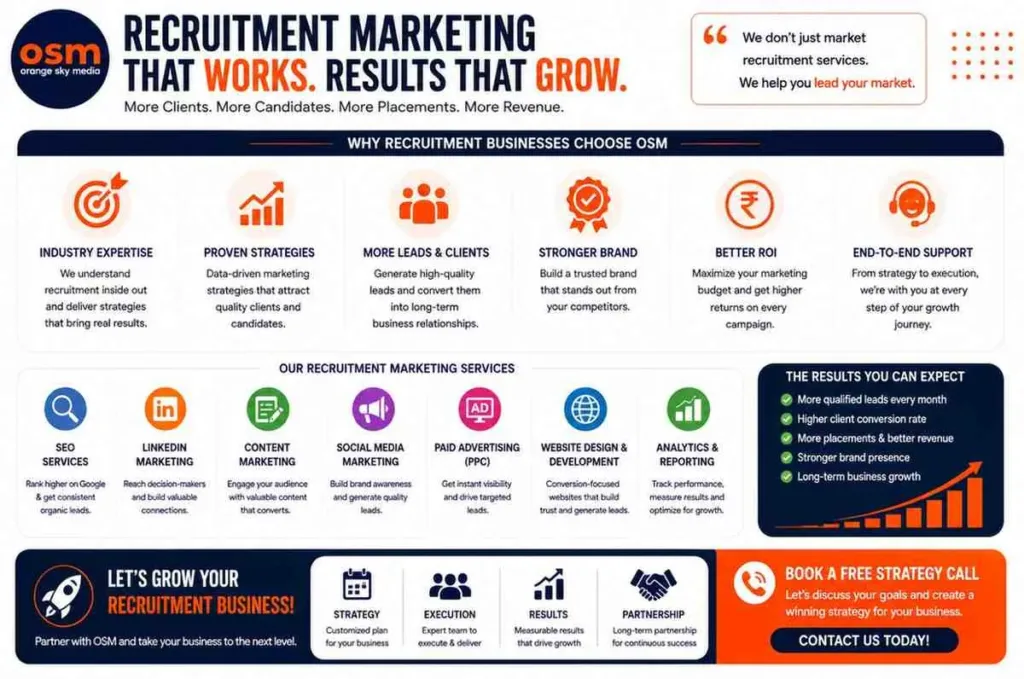
Build a Recruitment Agency That Employers Can Find and Trust
The recruitment industry has changed significantly over the past decade.
Employers no longer choose recruitment partners based solely on referrals or personal recommendations. They research online, compare agencies, read reviews, explore websites, and evaluate expertise before making a hiring decision.
This shift has made digital marketing one of the most valuable investments a recruitment agency can make.
Throughout this guide, we’ve explored how SEO, website development, content marketing, social media, employer branding, lead generation, AI, and performance measurement work together to create a strong digital presence.
These strategies are not independent marketing activities. They form a complete ecosystem that helps recruitment agencies:
- Increase online visibility.
- Build credibility.
- Educate employers.
- Generate qualified enquiries.
- Strengthen long-term client relationships.
- Achieve sustainable business growth.
The most successful recruitment agencies are not necessarily the largest or oldest.
They are the ones that consistently demonstrate expertise, build trust, and remain visible where employers are actively searching for recruitment solutions.
Digital marketing is no longer optional. It is an essential part of building a modern, competitive, and future-ready recruitment business.
Whether you are an executive search firm, staffing agency, overseas recruitment company, marine manning agency, healthcare recruiter, or industry-specific consultancy, the right digital strategy can help you reach more employers and grow with confidence.
Why Choose Orange Sky Media?
At Orange Sky Media, we understand that recruitment marketing is different from traditional digital marketing.
We have practical experience working with international recruitment businesses and understand how employers search, evaluate recruitment partners, and make hiring decisions.
Our recruitment marketing services include:
- Recruitment SEO
- Website Design & Development
- Technical SEO
- Content Marketing
- LinkedIn Marketing
- Social Media Management
- Employer Branding
- Lead Generation Strategy
- Google Business Profile Optimization
- AI-Powered Marketing Solutions
- Performance Reporting & Analytics
We don’t believe in generic marketing campaigns.
We create customized digital strategies that help recruitment agencies increase visibility, generate qualified employer enquiries, and build sustainable long-term growth.
Whether you’re launching a new recruitment agency or expanding into international markets, our team can help you build a digital presence that delivers measurable business results.
Ready to Grow Your Recruitment Agency?
If you’re looking to attract more employers, improve your online visibility, and build a long-term digital marketing strategy, Orange Sky Media is here to help.
Contact us today for a free consultation and discover how a tailored digital marketing strategy can help your recruitment agency generate more leads, strengthen its brand, and achieve sustainable growth.

Related Posts

Email Marketing for Recruitment Agencies: Lead Generation Guide
Many recruitment agencies underestimate the power of email marketing. Some believe it's outdated. Others assume…

Social Media Marketing for Recruitment Agencies
The Complete Guide to Building Your Employer Brand and Attracting Top Talent Introduction The way…

Website Development for Recruitment Agencies
The Complete Guide to Building a High Converting Recruitment Website The Recruitment Website Development Process:…
Leave a Reply