
SEO for Recruitment Agencies
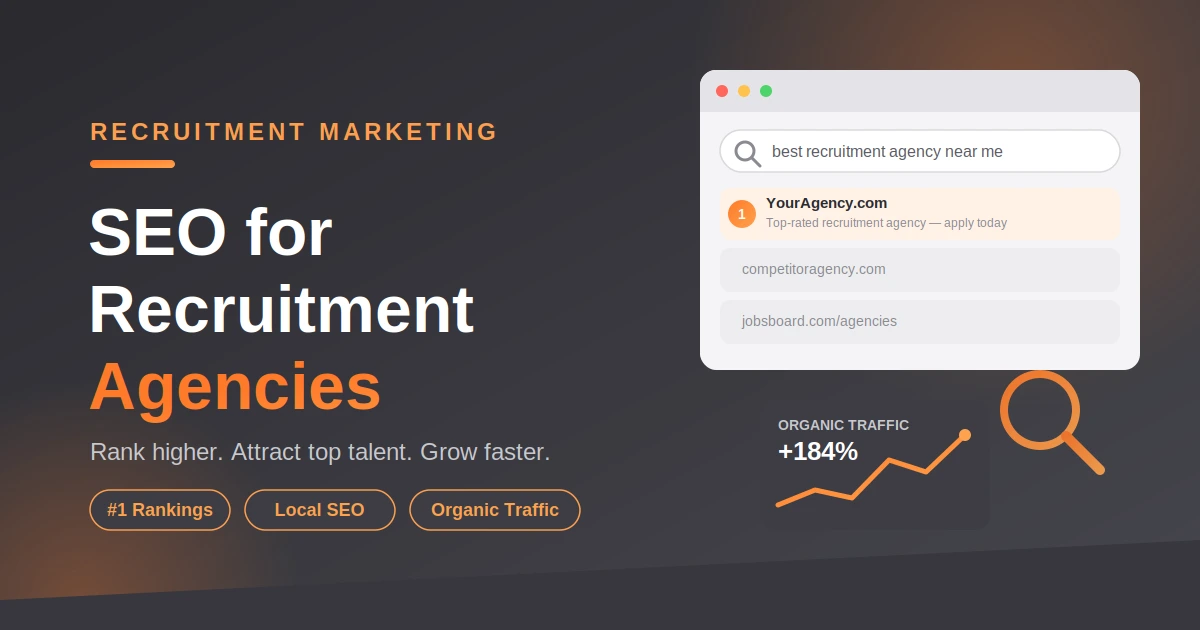
The Complete Guide to Rank Higher, Generate More Leads, and Grow Your Recruitment Business
Introduction
The recruitment industry has become more competitive than ever. Thousands of recruitment agencies, staffing companies, executive search firms, and HR consultancies are competing for the attention of both employers and job seekers online.
Today, most hiring managers begin their search for recruitment partners on Google. At the same time, candidates search for recruitment agencies that specialize in their industry, location, or job role. If your agency does not appear in these search results, you are likely losing valuable business to competitors who have invested in Search Engine Optimization (SEO).
SEO for recruitment agencies is more than simply ranking for a few keywords. It involves creating a fast, user-friendly website, publishing valuable content, optimizing service pages, building trust with search engines, and establishing your agency as an authority in the recruitment industry.
Unlike paid advertising, SEO provides sustainable, long-term growth. Once your website ranks well, it can consistently generate qualified employer enquiries and candidate applications without paying for every click.
Whether you are a local staffing company, an international recruitment agency, an executive search firm, or an overseas manpower consultancy, a well-planned SEO strategy can help you:
- Increase qualified website traffic
- Generate more employer enquiries
- Attract better candidates
- Improve brand credibility
- Reduce dependence on paid advertising
- Build long-term organic growth
In this comprehensive guide, you will learn everything about SEO for recruitment agencies, including keyword research, technical SEO, local SEO, international SEO, content marketing, AI search optimization, and proven strategies that help recruitment businesses rank higher on Google.
What is SEO for Recruitment Agencies?
Search Engine Optimization (SEO) for recruitment agencies is the process of improving a recruitment website so it appears higher in search engine results when employers and job seekers search for recruitment-related services.
Instead of relying only on paid advertising or referrals, SEO helps your website attract consistent organic traffic from Google, Bing, and AI-powered search platforms.
For example, your potential clients may search for:
- Recruitment agency in Mumbai
- Overseas recruitment agency
- Healthcare recruitment company
- IT staffing agency
- Executive search firm
- Marine recruitment agency
- Recruitment agency for Saudi Arabia
- Staffing company near me
Candidates may search for:
- Jobs in Dubai
- Nursing jobs abroad
- Engineering recruitment agencies
- Oil and gas recruitment company
- Construction jobs in Qatar
- Marine jobs
- Overseas jobs for Indians
A properly optimized recruitment website helps you rank for these searches and connect with the right audience at the right time.
SEO is not a single activity. It combines multiple disciplines, including:
- Keyword Research
- Technical SEO
- On Page SEO
- Local SEO
- International SEO
- Content Marketing
- Link Building
- User Experience Optimization
- AI Search Optimization
When all these components work together, your recruitment website becomes more visible, trustworthy, and competitive in search results.
Why SEO is Different for Recruitment Agencies
Recruitment websites have unique challenges compared to other industries.
Unlike a standard business website, a recruitment agency serves two different audiences:
- Employers looking to hire talent
- Candidates searching for job opportunities
This means your SEO strategy must address both user journeys while ensuring your website remains technically optimized and easy to navigate.
Recruitment agencies also deal with:
- Frequently changing job listings
- Location-specific searches
- Industry-specific hiring needs
- Seasonal recruitment trends
- International hiring requirements
- Large numbers of dynamic pages
These factors require a specialized SEO strategy rather than a generic approach.
How Recruitment SEO Supports Business Growth
An effective SEO strategy impacts every stage of your recruitment business.
It helps potential employers discover your services, encourages candidates to apply through your website, strengthens your online reputation, and creates a steady pipeline of qualified leads.
Instead of competing only through paid advertising, SEO allows your agency to build long-term visibility that continues to generate traffic even after your content has been published.
Some of the biggest business benefits include:
- Higher rankings on Google
- More qualified employer enquiries
- Increased candidate applications
- Better brand authority
- Lower customer acquisition costs
- Sustainable lead generation
- Stronger local and international visibility
- Higher website conversion rates
Over time, SEO becomes one of the most cost-effective marketing channels for recruitment agencies because it continues delivering value long after the initial optimization work is complete.
AI SEO for Recruitment Agencies: How to Stay Visible in AI Powered Search
Search is evolving rapidly. Traditional search engines still play a crucial role, but AI-powered search experiences are changing how people discover information and choose service providers.
Today, users don’t just search on Google. They also ask questions using tools like ChatGPT, Google AI Overviews, Microsoft Copilot, Perplexity AI, and other AI assistants. Instead of showing a list of links, these platforms often generate direct answers by summarizing information from trusted sources.
For recruitment agencies, this shift creates both new opportunities and new challenges.
Ranking on Google is still important, but the future of SEO also involves becoming a trusted source that AI systems reference when answering users’ questions.
Why AI SEO Matters
Imagine an HR Manager asks an AI assistant:
“Who are the best recruitment agencies for manufacturing hiring?”
Or asks:
“How can I improve recruitment for healthcare professionals?”
Instead of displaying ten blue links, the AI provides a summarized answer and recommends trusted resources.
If your website consistently publishes authoritative, well-structured, and helpful content, it has a much better chance of being referenced in these AI-generated responses.
AI SEO is about increasing your visibility wherever users search for information, not just on traditional search engines.
How AI Search is Different from Traditional SEO
Traditional SEO focuses on ranking web pages for specific keywords.
AI-powered search focuses on answering complete questions using reliable information.
Traditional Search
- User enters a keyword
- Search engine displays a list of websites
- User chooses which result to visit
AI Search
- User asks a complete question
- AI analyzes multiple trusted sources
- AI generates a summarized answer
- Relevant sources may be referenced
This means your content should answer questions clearly rather than simply targeting keywords.
1. Focus on Topical Authority
AI systems prefer websites that demonstrate deep expertise within a specific subject.
For recruitment agencies, this means building comprehensive content around recruitment marketing instead of publishing unrelated articles.
For example, create pillar pages covering:
- SEO for Recruitment Agencies
- Website Development for Recruitment Agencies
- Social Media Marketing for Recruitment Agencies
- Lead Generation for Recruitment Agencies
- Employer Branding
- AI for Recruitment Agencies
Then support these with detailed articles that explore each topic in depth.
A well-connected content hub signals expertise and improves both traditional SEO and AI visibility.
2. Answer Questions Clearly
AI models favor content that provides direct, concise, and helpful answers.
Instead of writing vague introductions, answer common questions early in your content.
For example:
What is Recruitment SEO?
Recruitment SEO is the process of optimizing a recruitment agency’s website to improve visibility in search engines and attract qualified employers and job seekers through organic search.
Providing clear definitions like this increases the likelihood that AI systems will reference your content.
3. Use Structured Content
AI systems understand well-organized content more effectively.
Use:
- Clear headings
- Short paragraphs
- Bullet points
- Numbered steps where appropriate
- Comparison tables
- Checklists
- Summary boxes
Well-structured pages are easier for both users and AI systems to interpret.
4. Demonstrate Experience and Expertise
Google’s quality guidelines emphasize Experience, Expertise, Authoritativeness, and Trustworthiness (E-E-A-T).
Recruitment agencies can strengthen these signals by including:
- Real case studies
- Industry experience
- Author biographies
- Team expertise
- Original research
- Recruitment insights
- Client success stories
AI systems are more likely to trust content that demonstrates real-world knowledge.
5. Publish Original Insights
Generic content is becoming less valuable.
Instead of repeating what already exists, share unique information such as:
- Hiring trends
- Salary reports
- Recruitment surveys
- Market analysis
- Candidate behavior
- Employer challenges
- Industry forecasts
Original insights help differentiate your website and make it more likely to be referenced.
6. Optimize for Conversational Search
People increasingly search using natural language.
Instead of typing:
Recruitment SEO
Users may ask:
- How can a recruitment agency rank higher on Google?
- What is the best SEO strategy for staffing companies?
- How do recruitment agencies generate organic leads?
- How can I improve my recruitment website?
Your content should answer these conversational queries naturally.
7. Add FAQ Sections
Frequently Asked Questions are valuable for both users and AI systems.
Examples:
How long does recruitment SEO take?
Is SEO better than Google Ads for recruitment agencies?
How much does recruitment SEO cost?
Can local recruitment agencies benefit from SEO?
Each answer should be concise, accurate, and easy to understand.
8. Use Structured Data
Schema markup helps search engines understand your content.
Useful schema types include:
- Article
- FAQ
- Organization
- Local Business
- Breadcrumb
- Service
- Job Posting
While schema alone doesn’t guarantee AI visibility, it improves content understanding and eligibility for enhanced search features.
9. Keep Content Updated
AI systems prefer current, relevant information.
Regularly update your content by:
- Refreshing statistics
- Adding recent trends
- Updating screenshots
- Expanding sections
- Improving examples
- Reviewing links
A regularly maintained resource is more likely to remain authoritative over time.
10. Build Brand Authority Beyond Your Website
AI models learn from a broad ecosystem of trusted sources.
Strengthen your online presence by maintaining consistent profiles and mentions across:
- Industry directories
- Business listings
- News articles
- Guest posts
- Professional associations
- Conference presentations
The more consistently your brand appears in reputable places, the stronger your overall authority becomes.
AI SEO Checklist
Before publishing content, ask yourself:
✔ Does the page answer real user questions?
✔ Is the information original and helpful?
✔ Is the content well-structured?
✔ Are headings clear and descriptive?
✔ Have you included FAQs?
✔ Does the article demonstrate expertise?
✔ Is schema markup implemented?
✔ Are examples relevant and practical?
✔ Is the content regularly updated?
✔ Does the page provide genuine value beyond ranking for keywords?
Common AI SEO Mistakes
As AI search becomes more common, avoid these pitfalls:
- Writing content only for keywords instead of users
- Publishing generic AI-generated articles without human review
- Ignoring E-E-A-T principles
- Failing to update outdated content
- Providing vague or incomplete answers
- Overlooking structured data
- Neglecting brand authority outside your website
The most successful content combines AI-assisted efficiency with genuine human expertise.
Preparing Your Recruitment Agency for the Future
AI will continue to influence how people search, but the fundamentals remain the same: create content that is accurate, trustworthy, and genuinely useful.
Recruitment agencies that invest in comprehensive resources, original insights, and a strong content strategy will be well-positioned to benefit from both traditional search engines and emerging AI-powered search experiences.
Rather than trying to optimize for a specific AI platform, focus on becoming the most reliable source of information in your niche. That approach will continue to deliver value as search technology evolves.
Key Takeaway
AI SEO is not replacing traditional SEO; it is expanding it. Recruitment agencies that create authoritative, well-structured, and user-focused content are more likely to be discovered through Google Search, AI Overviews, ChatGPT, Microsoft Copilot, Perplexity, and future AI-powered search platforms.
By combining strong technical SEO, comprehensive content, structured data, and real industry expertise, you can build a digital presence that remains competitive as search continues to evolve.
Common Recruitment SEO Mistakes to Avoid
Even with a well-designed website and valuable content, many recruitment agencies struggle to achieve strong search rankings because of avoidable SEO mistakes.
Some of these mistakes prevent search engines from properly understanding your website, while others create a poor experience for employers and candidates. Over time, these issues can reduce organic traffic, lower conversion rates, and make it difficult to compete with other agencies.
The good news is that most SEO mistakes can be identified and corrected with regular audits and a clear optimization strategy.
Let’s look at the most common mistakes recruitment agencies make and how to fix them.
1. Targeting the Wrong Keywords
One of the biggest mistakes is focusing only on broad, high-volume keywords.
For example:
- Recruitment
- Jobs
- Staffing
These keywords are extremely competitive and often too broad to attract qualified visitors.
Instead, target keywords with clear intent such as:
- SEO for Recruitment Agencies
- Healthcare Recruitment Agency
- Executive Search Firm in Mumbai
- Overseas Recruitment Agency
- Marine Recruitment Company
Long-tail and industry-specific keywords usually generate better leads.
2. Ignoring Search Intent
Ranking for a keyword is meaningless if the page doesn’t satisfy what users are looking for.
For example:
Someone searching:
Recruitment Agency in Dubai
expects to find recruitment services.
They do not want to read a 3,000-word blog explaining the history of recruitment.
Always match your content to the user’s intent.
3. Publishing Thin Content
Many recruitment websites have pages containing only a few paragraphs.
Examples include:
- Service pages with 200 words
- Location pages with duplicate text
- Industry pages with very little useful information
Google prefers pages that thoroughly answer users’ questions.
Instead of writing short pages, create comprehensive resources that demonstrate expertise.
4. Duplicate Content
Recruitment websites often duplicate content across:
- City pages
- Country pages
- Industry pages
- Job listings
Simply replacing one city name with another is not enough.
Every page should include unique information such as:
- Local industries
- Hiring trends
- Recruitment challenges
- Regional insights
Unique content improves rankings and provides more value for users.
5. Poor Website Structure
Many recruitment websites grow over time without a clear architecture.
Common problems include:
- Orphan pages
- Broken navigation
- Too many menu items
- Important pages buried deep within the site
A logical structure helps users and search engines navigate your website efficiently.
Example:
Home
↓
Recruitment Marketing
↓
SEO for Recruitment Agencies
↓
Technical SEO
↓
Keyword Research
↓
Local SEO
Every important page should be easy to find.
6. Weak Internal Linking
Internal links help search engines understand how your content is connected.
Many agencies publish blogs but never link them together.
For example:
Your article on Keyword Research for Recruitment Agencies should naturally link to:
- SEO for Recruitment Agencies
- Technical SEO
- Content Marketing
- AI SEO
- Recruitment SEO Checklist
Likewise, those pages should link back to the main pillar page.
Strong internal linking improves crawlability, distributes authority, and keeps users engaged.
7. Ignoring Technical SEO
A visually appealing website doesn’t always perform well in search.
Common technical issues include:
- Slow page speed
- Broken links
- Missing XML sitemap
- Crawl errors
- Poor mobile experience
- Duplicate meta tags
- Missing schema markup
Regular technical audits help identify and fix these issues before they affect rankings.
8. Keyword Stuffing
Some websites repeat the same keyword excessively in an attempt to improve rankings.
Example:
“Our recruitment agency is the best recruitment agency because our recruitment agency provides recruitment agency services.”
This creates a poor reading experience and can negatively impact SEO.
Instead, write naturally and use related terms where appropriate.
9. Neglecting Local SEO
Many agencies serve specific cities but fail to optimize for local searches.
Common mistakes include:
- No Google Business Profile
- Missing location pages
- Inconsistent contact information
- No customer reviews
- Lack of local backlinks
If you want to rank for searches like:
- Recruitment Agency in Mumbai
- Staffing Company in Pune
local SEO is essential.
10. Not Updating Content
SEO is not a one-time task.
Recruitment trends, salary expectations, hiring practices, and search behavior change regularly.
Outdated articles gradually lose relevance.
Review important pages every few months to:
- Update statistics
- Refresh examples
- Add new insights
- Improve internal links
- Expand content
Fresh content signals that your website remains current and useful.
11. Ignoring User Experience
Search engines reward websites that provide a positive user experience.
Common UX problems include:
- Confusing navigation
- Slow loading pages
- Difficult enquiry forms
- Poor mobile usability
- Excessive pop-ups
- Tiny fonts
- Cluttered layouts
A recruitment website should make it easy for employers to request services and candidates to apply for jobs.
12. Forgetting Conversion Optimization
Ranking well is only valuable if visitors take action.
Many recruitment websites fail because they don’t clearly guide users.
Every important page should include relevant calls to action, such as:
- Request a Free Consultation
- Submit Your Hiring Requirements
- Upload Your Resume
- Contact Our Recruitment Experts
- Book a Strategy Call
Strong CTAs turn traffic into business opportunities.
13. Depending Only on Google Ads
Some recruitment agencies invest heavily in paid advertising while ignoring SEO.
Paid campaigns can generate immediate traffic, but they stop delivering results when the budget ends.
SEO, on the other hand, builds a long-term asset that continues attracting employers and candidates over time.
The best approach combines both strategies:
- SEO for sustainable growth
- Paid advertising for immediate visibility
14. Measuring the Wrong Metrics
Many agencies celebrate metrics such as:
- Page views
- Impressions
- Social media likes
While these numbers are useful, they don’t necessarily reflect business success.
Focus on metrics that matter:
- Employer enquiries
- Candidate applications
- Organic traffic
- Keyword rankings
- Conversion rates
- Qualified leads
- Revenue generated from organic search
SEO should support measurable business growth, not just increase website traffic.
Recruitment SEO Health Checklist
Review your website regularly to ensure you’re avoiding common SEO issues.
✔ Target the right keywords
✔ Match content to search intent
✔ Publish comprehensive, original content
✔ Build strong internal links
✔ Optimize technical SEO
✔ Improve page speed
✔ Create unique location pages
✔ Maintain an optimized Google Business Profile
✔ Add schema markup
✔ Update content regularly
✔ Optimize for mobile devices
✔ Include clear calls to action
✔ Track meaningful SEO metrics
Key Takeaway
Most recruitment SEO challenges aren’t caused by Google’s algorithm—they’re caused by avoidable mistakes that gradually weaken a website’s performance.
By focusing on user intent, creating valuable content, maintaining a technically sound website, and regularly improving your SEO strategy, your recruitment agency can build stronger search visibility, attract higher-quality leads, and achieve sustainable long-term growth.
Remember, SEO is an ongoing process of continuous improvement. Agencies that consistently review and refine their websites are the ones that stay ahead of the competition.
Recruitment SEO Checklist: A Complete Action Plan
After understanding the fundamentals of recruitment SEO, the next step is implementation.
Many recruitment agencies know what SEO is but struggle with where to begin. Without a structured approach, it’s easy to overlook important tasks or focus on activities that have little impact.
This checklist provides a practical roadmap that you can use to build, optimize, and maintain a high-performing recruitment website. Whether you’re launching a new website or improving an existing one, following these steps will help create a strong foundation for long-term organic growth.
Phase 1: Website Foundation
Before focusing on content or rankings, ensure your website is technically sound.
Technical Setup Checklist
✅ Website uses HTTPS
✅ Mobile-friendly design
✅ Fast loading speed (under 3 seconds)
✅ Core Web Vitals optimized
✅ XML Sitemap submitted
✅ Robots.txt configured correctly
✅ Google Search Console connected
✅ Google Analytics 4 installed
✅ Bing Webmaster Tools connected
✅ Clean URL structure
✅ No crawl errors
✅ No broken links
✅ Canonical tags implemented
✅ Breadcrumb navigation
✅ Schema markup added
A technically healthy website allows search engines to crawl and index your content efficiently.
Phase 2: Keyword Research
Identify the keywords that your ideal clients and candidates actually search for.
Keyword Research Checklist
✅ Primary keyword for every page
✅ Secondary keywords identified
✅ Long-tail keywords included
✅ Local keywords researched
✅ Industry-specific keywords selected
✅ Employer-focused keywords
✅ Candidate-focused keywords
✅ Commercial intent keywords
✅ Informational keywords
✅ Keyword mapping completed
Avoid targeting the same keyword on multiple pages to prevent keyword cannibalization.
Phase 3: On Page SEO
Optimize every page individually.
On Page SEO Checklist
✅ SEO-friendly title tag
✅ Unique meta description
✅ One H1 heading
✅ Logical H2 and H3 structure
✅ Primary keyword naturally included
✅ Related keywords used appropriately
✅ Internal links added
✅ External references where relevant
✅ Optimized images
✅ ALT text written
✅ Clear call-to-action
✅ Readable formatting
Each page should target one primary topic and fully satisfy user intent.
Phase 4: Content Marketing
Content is the engine that drives organic traffic.
Content Checklist
✅ Pillar pages published
✅ Supporting blogs planned
✅ Industry guides created
✅ Case studies published
✅ FAQs added
✅ Recruitment checklists created
✅ Salary guides
✅ Hiring trend articles
✅ Employer resources
✅ Candidate resources
Quality always matters more than quantity.
Phase 5: Local SEO
If your agency serves specific cities or regions, optimize for local search.
Local SEO Checklist
✅ Google Business Profile optimized
✅ Accurate NAP details
✅ Business categories selected
✅ Location pages created
✅ Local keywords targeted
✅ Customer reviews collected
✅ Local citations built
✅ Local Business Schema added
✅ Maps listing verified
✅ Office photos uploaded
Local SEO helps you appear in Google Maps and “near me” searches.
Phase 6: International SEO
If you recruit internationally, optimize for each market.
International SEO Checklist
✅ Country-specific landing pages
✅ Localized content
✅ Country-specific keywords
✅ hreflang tags implemented
✅ Global site performance optimized
✅ International backlinks
✅ Region-specific blog content
✅ International testimonials
✅ Local regulations considered
Each country page should provide unique and relevant information rather than duplicate content.
Phase 7: Link Building
Build authority gradually through quality backlinks.
Link Building Checklist
✅ Guest articles
✅ Industry directories
✅ Digital PR
✅ Case studies
✅ Original research
✅ Recruitment reports
✅ Partnerships
✅ Testimonials
✅ Resource page outreach
✅ Internal linking improved
Focus on earning links naturally from trusted and relevant websites.
Phase 8: AI SEO
Prepare your content for AI-powered search experiences.
AI SEO Checklist
✅ Questions answered clearly
✅ Content well structured
✅ FAQs included
✅ Original insights
✅ Expert opinions
✅ Author information
✅ Structured data
✅ Updated information
✅ Easy-to-read formatting
Content that helps users first is also more likely to perform well in AI search.
Phase 9: User Experience
SEO and user experience work together.
UX Checklist
✅ Fast loading pages
✅ Responsive design
✅ Easy navigation
✅ Simple enquiry forms
✅ Click-to-call buttons
✅ Trust signals
✅ Client testimonials
✅ Easy job search
✅ Accessible contact information
Visitors should be able to find information and take action without confusion.
Phase 10: Measure Performance
SEO should always be measured using business outcomes, not just rankings.
KPI Checklist
Track:
✅ Organic traffic
✅ Keyword rankings
✅ Employer enquiries
✅ Candidate applications
✅ Contact form submissions
✅ Phone calls
✅ Conversion rate
✅ Organic leads
✅ Backlinks
✅ Returning visitors
Review these metrics monthly to identify opportunities for improvement.
Monthly Recruitment SEO Maintenance Checklist
SEO is an ongoing process. Set aside time each month to review your website and make improvements.
Every Month
✔ Publish at least one high-quality article
✔ Update older content with fresh information
✔ Review Google Search Console for indexing issues
✔ Monitor keyword rankings
✔ Check Core Web Vitals and page speed
✔ Fix broken links and crawl errors
✔ Add internal links to new content
✔ Respond to Google Business Profile reviews
✔ Analyze competitor activity
✔ Review conversion performance and user behavior
Consistent maintenance helps your website remain competitive as search algorithms and user expectations evolve.
Recruitment SEO Success Formula
A successful recruitment SEO strategy combines several elements working together:
Technical SEO
↓
Keyword Research
↓
On Page Optimization
↓
Content Marketing
↓
Local & International SEO
↓
Link Building
↓
AI SEO
↓
User Experience
↓
Continuous Improvement
↓
Higher Rankings
↓
More Organic Traffic
↓
More Employer Enquiries
↓
More Candidate Applications
↓
Business Growth
This isn’t a one-time project. It’s a continuous cycle of improvement that strengthens your website over time.
SEO is one of the most valuable long-term investments a recruitment agency can make. While it requires consistency and patience, the results can transform your website into a reliable source of qualified employer enquiries and candidate applications.
Rather than chasing quick wins, focus on building a technically sound website, publishing genuinely helpful content, earning trust through authority, and continuously improving the user experience.
The agencies that succeed with SEO are not necessarily those with the biggest budgets, but those that consistently provide the best information and the best experience for their audience.
By following this checklist and applying the strategies covered throughout this guide, your recruitment agency will be well positioned to increase search visibility, attract the right clients and candidates, and achieve sustainable growth through organic search.
Related Posts
Website Development for Recruitment Agencies
The Complete Guide to Building a High Converting Recruitment Website The Recruitment Website Development Process:…
Digital Marketing for Recruitment Agencies
Helping Recruitment Businesses Grow Through SEO, Branding, Content & Lead Generation Introduction The recruitment industry…
How Content Marketing Supports SEO and Lead Generation.
If you've ever wondered why some websites consistently rank higher, attract more visitors, and convert…
Leave a Reply