
Website Development for Recruitment Agencies
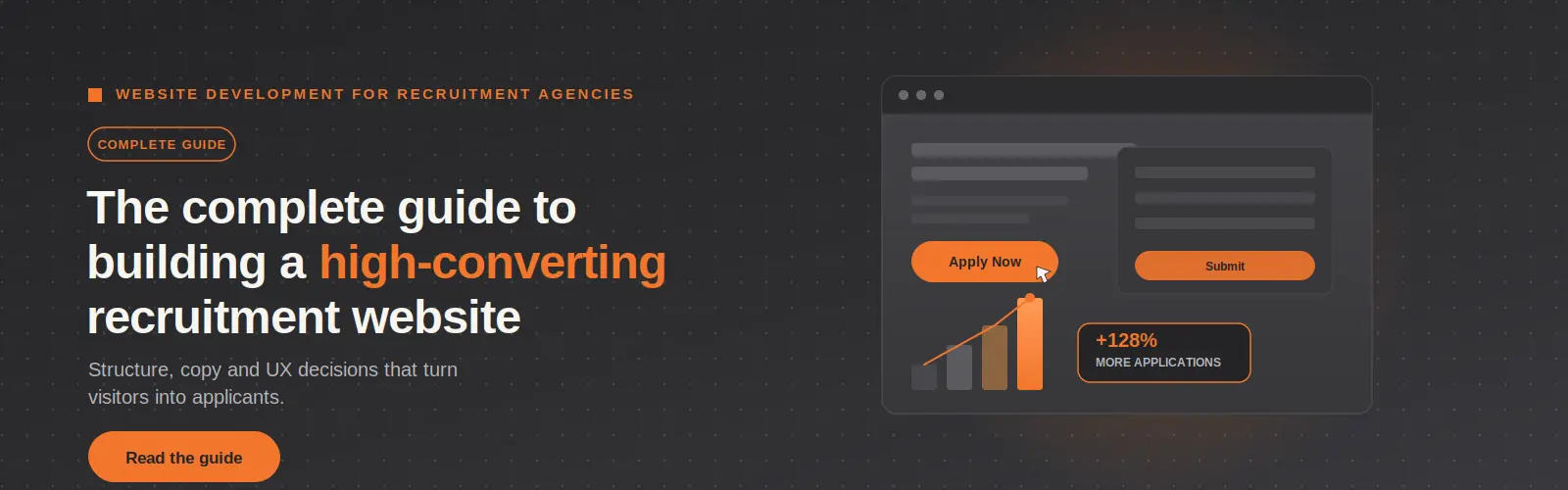
The Complete Guide to Building a High Converting Recruitment Website
The Recruitment Website Development Process: From Strategy to Launch
Building a recruitment website is much more than designing attractive pages and publishing content. A successful website is the result of careful planning, research, user experience design, technical development, testing, and continuous improvement.
Many recruitment agencies make the mistake of jumping straight into development without understanding their audience, business goals, or long-term marketing strategy. The result is often a website that looks modern but fails to generate enquiries, attract candidates, or rank well in search engines.
A structured website development process helps ensure that every decision supports your business objectives and creates a better experience for employers and job seekers.
Let’s explore each stage of the development journey.
Phase 1: Discovery and Business Analysis
Every successful project starts with understanding the business.
Before writing code or creating designs, it’s important to define what the website should achieve.
Ask questions such as:
- What recruitment services do we offer?
- Which industries do we specialize in?
- Who are our ideal clients?
- Which countries or locations do we recruit for?
- What actions do we want visitors to take?
- What makes our agency different from competitors?
This stage lays the foundation for every decision that follows.
Deliverables
- Business goals
- Target audience personas
- Competitor research
- Website objectives
- Feature requirements
- Project roadmap
Phase 2: Research and Content Planning
Once the business objectives are clear, the next step is planning the website’s content and structure.
Instead of creating pages randomly, organize content around user needs and search intent.
Typical planning includes:
- Website sitemap
- Service pages
- Industry pages
- Country or city pages
- Job portal structure
- Employer resources
- Candidate resources
- Blog categories
- Case studies
- Contact pages
This stage also includes keyword research to ensure each page targets relevant search terms.
Good content planning prevents duplication and creates a logical website architecture.
Phase 3: Wireframing and User Experience (UX)
Before visual design begins, create wireframes that define how each page will function.
Think of wireframes as blueprints for your website.
They help answer questions such as:
- Where should the navigation appear?
- How should service information be organized?
- Where should enquiry forms be placed?
- How many steps should the application process include?
- Which calls to action deserve the most visibility?
A recruitment website should guide visitors naturally from information to action.
For example:
Homepage
↓
Service Page
↓
Industry Expertise
↓
Case Studies
↓
Contact Form
↓
Consultation Request
A strong user experience reduces confusion and increases conversions.
Phase 4: UI Design and Brand Identity
Once the structure is finalized, visual design begins.
The interface should reflect your agency’s professionalism while remaining clean and easy to navigate.
Key design elements include:
- Consistent branding
- Professional typography
- Accessible color palette
- High-quality imagery
- Clear icons
- Spacious layouts
- Mobile-first design
- Prominent calls to action
Avoid overcrowding pages with excessive text, animations, or distracting visuals. Simplicity often creates a stronger user experience.
Phase 5: Website Development
This is where the approved designs are transformed into a fully functional website.
Developers build the website using a suitable content management system (CMS) or custom framework while ensuring the site is secure, responsive, and scalable.
Core development tasks include:
- Front-end development
- Back-end development
- CMS implementation
- Job portal setup
- Employer enquiry forms
- ATS integration
- CRM integration
- API connections
- Database configuration
- User account functionality
At this stage, performance and scalability should be considered alongside functionality.
Phase 6: SEO and Performance Optimization
SEO should never be treated as an afterthought.
Before launch, every page should be optimized for search engines and user experience.
Key tasks include:
- Optimized page titles
- Meta descriptions
- Heading hierarchy
- Image optimization
- Internal linking
- Schema markup
- XML sitemap
- Robots.txt
- Canonical tags
- Mobile optimization
- Core Web Vitals improvements
A technically optimized website provides a strong foundation for future SEO efforts.
Phase 7: Testing and Quality Assurance
Before going live, every feature should be thoroughly tested.
Testing should cover:
Functionality
- Navigation
- Forms
- Job applications
- Search functionality
- Downloads
- Email notifications
Performance
- Page speed
- Mobile responsiveness
- Browser compatibility
- Accessibility
- Security
Content
- Spelling and grammar
- Broken links
- Missing images
- Duplicate pages
- Contact details
A detailed quality assurance process minimizes issues after launch and improves user confidence.
Phase 8: Website Launch
Launching a website is more than clicking the “Publish” button.
Before launch, confirm that:
- Analytics tools are installed
- Search Console is configured
- Sitemap has been generated
- Redirects are in place (if redesigning)
- SSL certificate is active
- Backup systems are configured
- Forms are functioning correctly
After launch, submit the website to search engines and monitor its performance closely during the first few weeks.
Phase 9: Ongoing Maintenance and Improvement
A website is never truly finished.
Recruitment trends, technology, user expectations, and search engine algorithms continue to evolve.
Regular maintenance should include:
- Updating content
- Adding new job listings
- Publishing blogs
- Improving page speed
- Fixing technical issues
- Updating plugins and software
- Monitoring analytics
- Reviewing SEO performance
- Testing user experience
Continuous improvement ensures your website remains competitive and effective over time.
The Complete Website Development Workflow
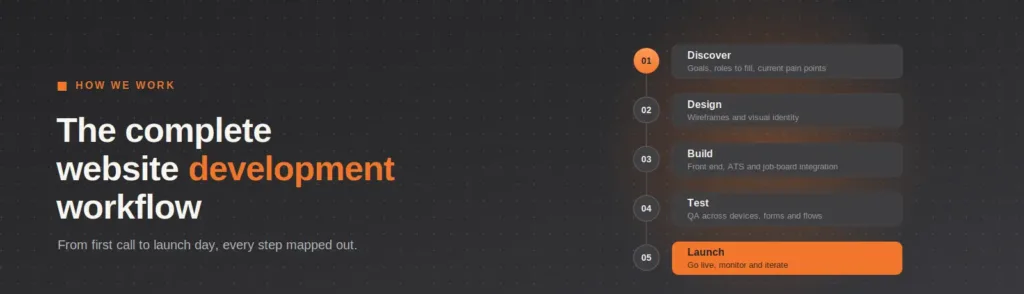
A successful recruitment website follows a clear and repeatable process:
Business Discovery
↓
Research & Planning
↓
Website Architecture
↓
Wireframes & UX
↓
UI Design
↓
Website Development
↓
ATS & CRM Integration
↓
SEO Optimization
↓
Testing & Quality Assurance
↓
Website Launch
↓
Performance Monitoring
↓
Continuous Improvement
Each phase builds upon the previous one, ensuring the final website is not only visually appealing but also functional, scalable, and aligned with your business goals.
Common Development Mistakes to Avoid
Even well-intentioned projects can fail if key planning steps are overlooked. Avoid these common mistakes:
- Starting development without a clear sitemap
- Designing for aesthetics instead of user experience
- Ignoring mobile responsiveness
- Treating SEO as a post-launch task
- Using generic templates without customization
- Creating slow, image-heavy pages
- Forgetting clear calls to action
- Skipping user testing before launch
- Neglecting ongoing maintenance after the website goes live
Avoiding these pitfalls saves time, reduces costs, and results in a website that performs better from day one.
Key Takeaway
A successful recruitment website isn’t built in a single step. It’s the outcome of a structured development process that combines strategic planning, thoughtful design, technical excellence, and continuous optimization.
By following a clear roadmap from discovery to long-term maintenance, recruitment agencies can create websites that not only look professional but also attract employers, engage candidates, improve search visibility, and generate measurable business results.
Next Section
SEO Friendly Website Development for Recruitment Agencies
In the next section, we’ll explore how website development decisions directly impact search engine rankings, covering site speed, Core Web Vitals, mobile-first design, technical SEO, structured data, and development best practices that help recruitment websites perform better on Google.
next
SEO Friendly Website Development for Recruitment Agencies
A beautiful website means very little if potential clients can’t find it on Google.
Many recruitment agencies treat SEO as the final step after a website is built. They publish the website first and think about optimization later. Unfortunately, this approach often results in expensive redesigns, technical issues, and poor search visibility.
The most successful recruitment websites are built with SEO in mind from day one.
SEO-friendly website development is the practice of designing and developing a website that is easy for search engines to crawl, understand, and rank while also providing an exceptional experience for users.
When website development and SEO work together, the result is a faster, more accessible, and higher-performing website that attracts consistent organic traffic and generates quality enquiries.
Why SEO Should Be Part of Website Development
Search engines evaluate hundreds of factors before deciding where a website should rank.
Many of these factors are directly influenced by the way a website is developed.
For example:
- Is the website fast?
- Does it work well on mobile devices?
- Can Google easily crawl every page?
- Is the website secure?
- Does the content have a logical structure?
- Are pages connected through internal links?
- Does the website provide a good user experience?
If these fundamentals are ignored during development, even the best content may struggle to rank.
SEO is not an add-on. It is part of the website’s foundation.
Build the Right Website Structure
Search engines prefer websites with a clear hierarchy.
Every important page should be easy to discover within a few clicks.
A recruitment website should follow a logical structure like this:
Home
│
├── Recruitment Services
├── Industries
├── Locations
├── Employers
├── Candidates
├── Job Portal
├── Resources
└── Contact
Each category should expand into relevant subpages.
For example:
Industries
- Healthcare Recruitment
- IT Recruitment
- Manufacturing Recruitment
- Marine Recruitment
- Construction Recruitment
This structure helps both users and search engines understand the relationship between pages.
Create SEO Friendly URLs
Your URL should clearly describe the page.
Good examples include:
/healthcare-recruitment
/executive-search
/jobs/software-engineer-dubai
/recruitment-agency-mumbai
Avoid URLs such as:
/page?id=102
/service1
/newpage-final
Clean URLs improve usability, indexing, and keyword relevance.
Optimize Website Speed
Page speed is one of the most important technical factors affecting both SEO and user experience.
Research consistently shows that visitors are less likely to stay on slow websites. Even a delay of a few seconds can increase bounce rates and reduce conversions.
To improve website speed:
- Compress images before uploading
- Use modern image formats such as WebP
- Minify CSS, JavaScript, and HTML
- Enable browser caching
- Use lazy loading for images
- Choose a reliable hosting provider
- Implement a Content Delivery Network (CDN)
- Reduce unnecessary plugins and scripts
A fast website not only ranks better but also creates a smoother experience for employers and candidates.
Design for Mobile First
Most candidates search for jobs using smartphones, while many employers also browse recruitment websites on mobile devices.
Google primarily evaluates the mobile version of your website when determining search rankings.
Your website should provide:
- Responsive layouts
- Easy-to-read text
- Mobile-friendly navigation
- Clickable buttons
- Fast mobile performance
- Simplified enquiry forms
If visitors struggle to use your website on mobile, they are likely to leave and choose a competitor.
Improve Core Web Vitals
Core Web Vitals are Google’s key metrics for measuring user experience.
Recruitment websites should focus on:
Largest Contentful Paint (LCP)
Measures how quickly the main content loads.
Improve by:
- Optimizing images
- Using faster hosting
- Reducing render-blocking resources
Interaction to Next Paint (INP)
Measures how quickly a website responds to user interactions.
Improve by:
- Reducing unnecessary JavaScript
- Optimizing forms
- Improving button responsiveness
Cumulative Layout Shift (CLS)
Measures visual stability.
Avoid:
- Images without defined dimensions
- Unexpected content shifts
- Poorly sized advertisements
Stable layouts improve usability and reduce frustration.
Implement Technical SEO Best Practices
During development, ensure that technical SEO essentials are included from the start.
These include:
- XML Sitemap
- Robots.txt
- HTTPS security
- Canonical tags
- Breadcrumb navigation
- Structured data
- Optimized meta tags
- Clean heading hierarchy
- Internal linking
- Pagination for job listings where needed
These technical elements help search engines crawl and understand your website more effectively.
Use Structured Data (Schema Markup)
Schema markup provides additional context about your content.
For recruitment websites, useful schema types include:
- Organization
- Local Business
- Service
- Job Posting
- Article
- FAQ
- Breadcrumb
- Person (for recruiters or leadership)
Schema can improve eligibility for rich search results and helps search engines interpret your content more accurately.
Optimize Images for Performance and SEO
Images enhance user experience but can negatively impact performance if not optimized.
Follow these best practices:
- Use descriptive file names
- Add meaningful ALT text
- Compress images before uploading
- Serve responsive image sizes
- Use WebP where supported
- Avoid uploading oversized files
Optimized images contribute to faster loading times and improved accessibility.
Build a Strong Internal Linking Structure
Internal links help users discover related content and assist search engines in understanding your website.
For example:
A page about Healthcare Recruitment can naturally link to:
- Recruitment Services
- Healthcare Hiring Guide
- Employer Resources
- Healthcare Salary Guide
- Contact Recruitment Consultant
Similarly, blog articles should link back to relevant service pages, industry pages, and pillar guides.
A strong internal linking strategy distributes authority across your website and encourages visitors to explore additional content.
Secure Your Website
Website security is an important ranking factor and a trust signal for users.
Every recruitment website should include:
- SSL certificate (HTTPS)
- Secure enquiry forms
- Spam protection
- Regular software updates
- Strong password policies
- Firewall protection
- Automated backups
A secure website protects user data and builds confidence among employers and candidates.
Development Checklist Before Launch
Before launching your recruitment website, confirm that the following tasks are complete:
✔ Mobile responsiveness tested
✔ Core Web Vitals optimized
✔ XML sitemap generated
✔ Robots.txt configured
✔ SSL certificate installed
✔ Google Analytics 4 connected
✔ Google Search Console verified
✔ Schema markup implemented
✔ Internal links reviewed
✔ Meta titles and descriptions added
✔ Images optimized
✔ Forms tested
✔ Broken links fixed
✔ 404 page created
✔ Redirects configured (if redesigning an existing website)
Launching with these elements already in place gives your website a stronger SEO foundation from day one.
Key Takeaway
SEO-friendly website development is not about adding keywords after the website is complete. It is about making smart technical and structural decisions throughout the development process.
From planning the site architecture and optimizing page speed to implementing structured data and designing for mobile users, every development decision influences how well your recruitment website performs in search engines.
By integrating SEO into every stage of website development, recruitment agencies create websites that are easier to discover, faster to use, and more effective at generating long-term organic traffic and qualified business enquiries.
Future Trends in Recruitment Website Development
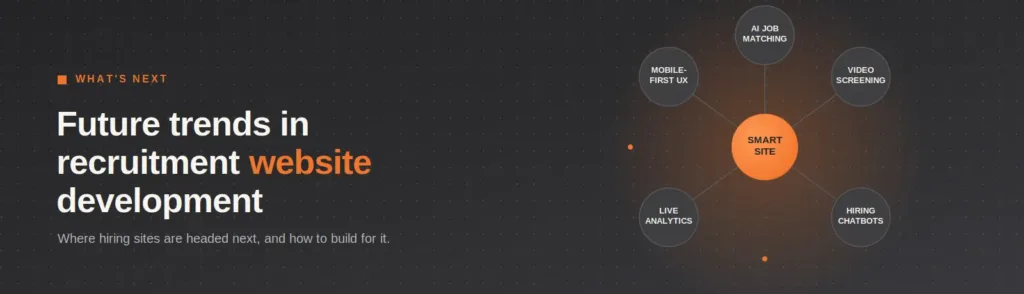
The recruitment industry is evolving faster than ever before. Advances in artificial intelligence, automation, and changing user expectations are transforming how employers hire talent and how candidates search for jobs.
A recruitment website that meets today’s standards may not be enough to compete tomorrow.
Modern recruitment agencies need websites that are intelligent, personalized, and built to adapt to future technologies. The goal is no longer just to provide information but to deliver seamless digital experiences that simplify hiring, improve engagement, and support business growth.
Understanding these emerging trends helps agencies make smarter development decisions and invest in features that will remain valuable for years to come.
1. Artificial Intelligence Will Become a Standard Feature
Artificial Intelligence is already reshaping recruitment.
Today’s AI tools can analyze resumes, answer candidate questions, recommend jobs, and automate repetitive recruitment tasks.
Future recruitment websites will increasingly include AI-powered features such as:
- Intelligent job recommendations
- Resume matching
- Candidate screening
- Automated interview scheduling
- Personalized content recommendations
- AI-powered chat support
Rather than replacing recruiters, AI will help recruitment teams work faster and focus on building stronger relationships with employers and candidates.
2. Personalized Website Experiences
Every visitor has different needs.
An employer looking to hire senior executives should not see the same homepage experience as a graduate searching for entry-level opportunities.
Future recruitment websites will personalize content based on user behavior.
For example:
Employers may see
- Recruitment services
- Industry expertise
- Case studies
- Consultation forms
- Employer resources
Candidates may see
- Recommended jobs
- Career advice
- Resume submission
- Interview preparation
- Job alerts
Personalization improves engagement because visitors immediately receive content that matches their interests.
3. Conversational Search and AI Assistants
Search behavior is changing.
Instead of searching:
“Recruitment Agency Mumbai”
Users increasingly ask:
“Which recruitment agency specializes in manufacturing hiring in Mumbai?”
or
“Who can help us recruit healthcare professionals for the UAE?”
AI assistants such as ChatGPT, Google AI Overviews, Microsoft Copilot, and Perplexity encourage conversational queries rather than simple keywords.
Recruitment websites should therefore:
- Answer complete questions.
- Include detailed FAQs.
- Use clear headings.
- Publish comprehensive guides.
- Structure content logically.
These practices improve visibility in both traditional and AI-powered search.
4. Smarter Job Search Experiences
Traditional keyword-based job search is gradually being replaced by intelligent recommendations.
Future job portals will understand candidate preferences and suggest opportunities based on:
- Skills
- Experience
- Education
- Previous applications
- Preferred locations
- Career goals
This creates a more relevant and engaging experience for job seekers.
5. Progressive Web Applications (PWAs)
Users expect websites to load instantly and work reliably on every device.
Progressive Web Applications combine the accessibility of a website with the experience of a mobile application.
Benefits include:
- Faster loading
- Offline functionality
- Push notifications
- Better mobile performance
- Improved user engagement
For recruitment agencies with frequent candidate interactions, PWAs can significantly enhance the application experience.
6. Voice Search Optimization
Voice-enabled devices continue to influence how users search online.
Candidates may ask:
“Find nursing jobs near me.”
Employers may ask:
“Who provides executive recruitment services in Bangalore?”
Recruitment websites should prepare by:
- Using conversational language.
- Answering common questions directly.
- Creating FAQ sections.
- Optimizing for local searches.
- Implementing structured data.
Voice search optimization also improves accessibility for a wider audience.
7. Automation Across Recruitment Workflows
Automation reduces repetitive administrative tasks and improves response times.
Modern recruitment websites increasingly integrate with:
- ATS platforms
- CRM systems
- Email automation
- Calendar scheduling
- Interview management tools
- Marketing automation software
These integrations allow agencies to respond more quickly while maintaining consistent communication with employers and candidates.
8. Stronger Data Security and Privacy
Recruitment websites handle sensitive personal information, including resumes, identification documents, employment history, and contact details.
As privacy regulations continue to evolve, websites must prioritize:
- Secure data storage
- Encrypted communications
- Consent management
- Role-based access controls
- Regular security updates
- Secure file uploads
Protecting user data is essential for maintaining trust and complying with legal requirements.
9. Accessibility by Design
An inclusive recruitment website ensures that everyone, including users with disabilities, can access information and apply for opportunities.
Future-ready websites should follow accessibility best practices such as:
- Keyboard-friendly navigation
- High color contrast
- Descriptive ALT text
- Screen reader compatibility
- Accessible forms
- Clear typography
Accessibility improves usability for all visitors while expanding your potential audience.
10. Continuous Improvement Through Data
The best recruitment websites are never static.
They evolve based on real user behavior.
Modern analytics tools help agencies understand:
- Which pages generate the most enquiries
- Where candidates abandon applications
- Which industries attract the highest traffic
- Which recruitment services convert best
- How users navigate the website
These insights support continuous optimization and smarter business decisions.
Preparing Your Recruitment Website for the Future
Technology will continue to change, but certain principles will remain constant.
Future-ready recruitment websites should be:
- Fast
- Secure
- Mobile-friendly
- SEO optimized
- Easy to navigate
- Scalable
- Accessible
- Data-driven
- Integrated with recruitment technology
- Focused on delivering exceptional user experiences
Agencies that invest in these fundamentals will adapt more easily as new technologies emerge.
The Future Recruitment Website Ecosystem
A modern recruitment website is becoming the central intelligence hub of the agency.
AI & Automation
│
Conversational Search
│
Marketing Channels
│
Recruitment Website
│
ATS + CRM + Analytics
│
Employer Experience
│
Candidate Experience
│
Business Growth
Rather than functioning as a static website, it becomes a connected digital platform that supports marketing, recruitment, operations, and customer engagement.
Key Takeaway
The future of recruitment website development is driven by intelligence, automation, personalization, and user experience. Agencies that embrace these trends today will be better equipped to attract top talent, serve employers more effectively, and remain competitive in an increasingly digital recruitment landscape.
Instead of chasing every new technology, focus on building a flexible, scalable website that can integrate with emerging tools while continuing to deliver a fast, trustworthy, and engaging experience for every visitor.
Conclusion
A recruitment website is no longer just a marketing asset. It is the digital foundation of your recruitment business.
From creating a clear website architecture and delivering an exceptional user experience to integrating ATS platforms, optimizing for search engines, and preparing for AI-powered recruitment, every development decision contributes to your agency’s long-term success.
The most successful recruitment websites don’t simply look professional. They solve problems, answer questions, build trust, and guide employers and candidates toward meaningful action.
Whether you’re launching a new recruitment website or modernizing an existing one, focus on creating a platform that is user-centric, technically sound, and built for growth. By combining strategic planning, modern technology, and continuous optimization, your website can become one of your agency’s most valuable business assets and a consistent source of leads, applications, and lasting client relationships.
Related Posts
SEO for Recruitment Agencies
The Complete Guide to Rank Higher, Generate More Leads, and Grow Your Recruitment Business Introduction…
Digital Marketing for Recruitment Agencies
Helping Recruitment Businesses Grow Through SEO, Branding, Content & Lead Generation Introduction The recruitment industry…
How Content Marketing Supports SEO and Lead Generation.
If you've ever wondered why some websites consistently rank higher, attract more visitors, and convert…
Leave a Reply